Quotient Rule for Derivatives: Formula, Mnemonic and Examples
The quotient rule: (f/g)' = (f'g − fg')/g². The formula, the low d-high mnemonic, worked examples, when to avoid it and common mistakes.
Derivative rules Updated 2 min read
At a glance
- Applies to
- A quotient of two differentiable functions, wherever g(x) \ne 0
- In words
- Low d-high minus high d-low, over low squared
- Order matters
- Yes, the numerator has a subtraction, so start with f'g
- Avoid it when
- The denominator is a constant or a single power of x
- Derived from
- The product rule and chain rule applied to f \cdot g^{-1}
On this page
The quotient rule finds the derivative of one function divided by another. Like the product rule, it is not what you might first guess: the derivative of \frac{f}{g} is not \frac{f'}{g'}. The numerator has a subtraction, so the order of the terms matters.
The quotient rule formula
If f and g are differentiable and g(x) \ne 0, then
The classic mnemonic, with "high" as the numerator and "low" as the denominator:
Low d-high minus high d-low, over low squared.
Worked examples
Example 1: a rational function. For \frac{x^2}{x + 1}, take f = x^2, f' = 2x, g = x + 1, g' = 1:
Example 2: simplify the numerator. For \frac{3x - 1}{x^2 + 1}:
Example 3: the derivative of \tan x. Write \tan x = \frac{\sin x}{\cos x}:
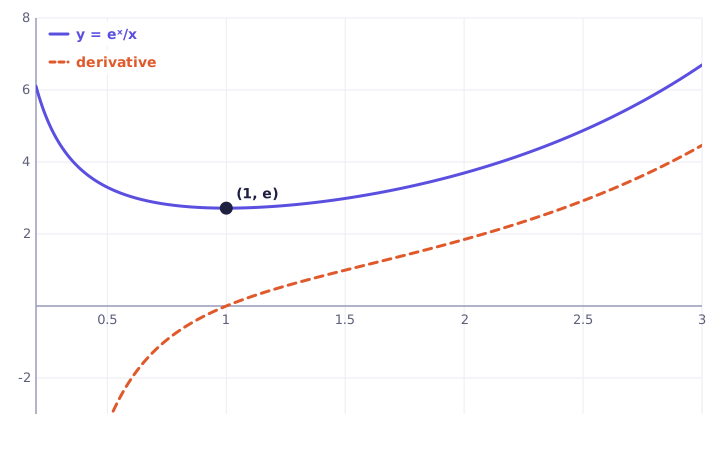
Example 4: an exponential over a power. For \frac{e^x}{x}:
When to skip the quotient rule
A fraction does not always need the quotient rule. Rewriting is often faster and less error-prone:
| Function | Rewrite | Derivative |
|---|---|---|
| \frac{x^3}{5} | \frac{1}{5}x^3 | \frac{3}{5}x^2 |
| \frac{4}{x^2} | 4x^{-2} | -\frac{8}{x^3} |
| \frac{x^3 + x}{x} | x^2 + 1 (for x \ne 0) | 2x |
| \frac{2}{\sqrt{x}} | 2x^{-1/2} | -x^{-3/2} |
The first uses the constant multiple rule; the others use the power rule and sum rule.
Where the quotient rule comes from
Write \frac{f}{g} = f \cdot g^{-1}. The product rule and the chain rule give
So you can always fall back on the product rule if you forget the formula.
Common mistakes
- Swapping the order in the numerator. fg' - f'g gives the negative of the right answer.
- Forgetting to square the denominator. The bottom is g^2, not g.
- Dividing the derivatives. \left(\frac{f}{g}\right)' \ne \frac{f'}{g'}.
- Expanding the denominator. Leave (x+1)^2 factored. It keeps the answer simpler and makes zeros and sign changes easy to see.
- Confusing it with L'Hôpital's rule. L'Hôpital's rule differentiates the top and bottom separately to find a limit. The quotient rule finds a derivative.
For a longer walkthrough of both rules together, read the full guide to the product and quotient rules.
Practice it now
The quotient rule
Solve real problems on this topic with instant feedback, hints and a step-by-step walkthrough for every answer. Free, no sign-up needed to start.
Practice this lesson