Square Root Function √x: Graph, Domain, Derivative and Integral
The square root function f(x) = √x: its domain and graph, the derivative 1/(2√x), the integral (2/3)x^(3/2) + C, and the vertical tangent at 0.
Algebraic functions Updated 3 min read
At a glance
- Domain
- [0, \infty)
- Range
- [0, \infty)
- Derivative
- \frac{1}{2\sqrt{x}}
- Integral
- \frac{2}{3}x^{3/2} + C
- Not differentiable at
- x = 0 (vertical tangent)
- Inverse
- x^2 for x \ge 0
On this page
The square root function f(x) = \sqrt{x} returns the nonnegative number whose square is x. It is the inverse of x^2 on x \ge 0, the power function with exponent \frac{1}{2}, and the standard example of a function that is continuous at a point but not differentiable there.
Formula
By convention \sqrt{x} means the principal (nonnegative) root, so \sqrt{9} = 3, not \pm 3. As a consequence, \sqrt{x^2} = |x| for every real x.
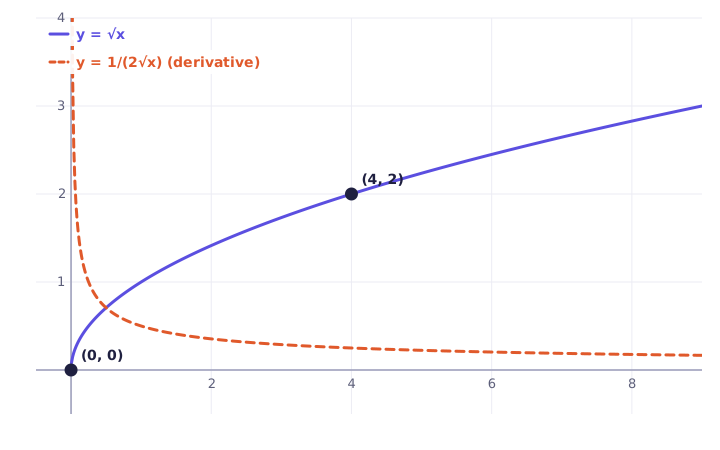
Graph of the square root function
Key properties
- Domain and range: both [0, \infty).
- Increasing on its whole domain, since its derivative is positive for x > 0.
- Concave down: f''(x) = -\frac{1}{4}x^{-3/2} < 0 for x > 0, so it grows ever more slowly.
- Continuous at 0 from the right, with \lim_{x \to 0^+}\sqrt{x} = 0.
- Not differentiable at 0, where the tangent is vertical.
- Unbounded but slow: \sqrt{x} \to \infty as x \to \infty, slower than any positive power x^p with p > \frac{1}{2}.
- Reflection of a parabola: the graph is the right half of y = x^2 reflected over the line y = x.
Derivative of √x
Using the power rule on x^{1/2}:
With the chain rule this becomes the general pattern
Integral of √x
Add one to the exponent (\frac{1}{2} + 1 = \frac{3}{2}) and divide by \frac{3}{2}, which is the same as multiplying by \frac{2}{3}.
Worked examples
Example 1: tangent line. At x = 4, f(4) = 2 and f'(4) = \frac{1}{2 \cdot 2} = \frac{1}{4}. The tangent line is y = 2 + \frac{1}{4}(x - 4) = \frac{1}{4}x + 1.
Example 2: linear approximation. Using that tangent line, \sqrt{4.2} \approx \frac{1}{4}(4.2) + 1 = 2.05. The true value is about 2.0494. See linear approximation.
Example 3: chain rule. \frac{d}{dx}\sqrt{3x + 1} = \frac{3}{2\sqrt{3x + 1}}.
Example 4: definite integral. \int_0^4 \sqrt{x}\,dx = \left[\frac{2}{3}x^{3/2}\right]_0^4 = \frac{2}{3}(8) = \frac{16}{3}.
Example 5: domain. \sqrt{4 - x^2} requires 4 - x^2 \ge 0, so the domain is [-2, 2]. Its graph is the upper half of the circle x^2 + y^2 = 4.
Common mistakes
- Splitting a root over a sum. \sqrt{x^2 + 9} \ne x + 3. Roots split over products, \sqrt{ab} = \sqrt{a}\sqrt{b} for a, b \ge 0, but never over sums.
- Writing the derivative as \frac{1}{\sqrt{x}} or 2\sqrt{x}. The factor is \frac{1}{2} and the root stays in the denominator.
- Integrating to \frac{3}{2}x^{3/2}. Divide by \frac{3}{2}; do not multiply.
- Assuming \sqrt{x^2} = x. It equals |x|, which matters when x can be negative.
How it connects
Square roots appear in arc length, distance formulas and trig substitution integrals like \int \sqrt{1 - x^2}\,dx. They are one member of the power functions, and \sqrt{x^2} = |x| links them to the absolute value function.
Practice it now
The power rule
Solve real problems on this topic with instant feedback, hints and a step-by-step walkthrough for every answer. Free, no sign-up needed to start.
Practice this lesson