AP Calc Unit 3 Review: Chain Rule and Implicit (AB and BC)
AP Calculus Unit 3 review for AB and BC: the chain rule, implicit differentiation, inverse and inverse trig derivatives, and higher-order derivatives.
AP Calculus units Updated 3 min read
At a glance
- AB exam weight
- 5–10%
- BC exam weight
- 5–10%
- Big ideas
- Chain rule, implicit differentiation, inverse functions, second derivatives
- BC only
- None, AB and BC cover the same Unit 3 topics
- Comes before
- Unit 4, derivatives in context, and Unit 5, analyzing functions
- Practice here
- Calculus 1: Derivative rules
AP Calculus Unit 3, Differentiation: Composite, Implicit, and Inverse Functions, finishes the toolkit of derivative rules. The chain rule lets you differentiate a function inside another function. Implicit differentiation handles curves that are not written as y = f(x). Inverse functions get their own derivative formula. It is a short unit, but you will use it every day for the rest of the course.
| AP Calculus AB | AP Calculus BC | |
|---|---|---|
| Exam weight | 5–10% | 5–10% |
| Extra topics | none | none |
What Unit 3 covers
College Board splits the unit into these topics. Each row links to a lesson where you can practice it with new numbers every time.
| Topic | What you learn | Practice |
|---|---|---|
| The chain rule | Differentiating f(g(x)) | Chain rule: general |
| Chain rule with powers and trig | (3x + 1)^5, \sin(x^2), \cos^3 x | Chain rule: powers |
| Chain rule with exponentials | e^{x^2}, \ln(\sin x) | Chain rule: exponentials |
| Implicit differentiation | Finding \frac{dy}{dx} for x^2 + y^2 = 25 | Implicit differentiation |
| Differentiating inverse functions | g'(b) = \frac{1}{f'(a)} when f(a) = b | Inverse function derivatives |
| Inverse trig functions | Derivatives of \arcsin x, \arctan x and the rest | Inverse trig derivatives |
| Selecting procedures | Choosing the right rule for a mixed expression | Derivative rules practice |
| Higher-order derivatives | f''(x), including implicit second derivatives | Derivative rules practice |
The key ideas
The chain rule works from the outside in. For y = f(g(x)):
Differentiate the outside function and leave the inside alone, then multiply by the derivative of the inside. Read the full chain rule page for a proof and more variants.
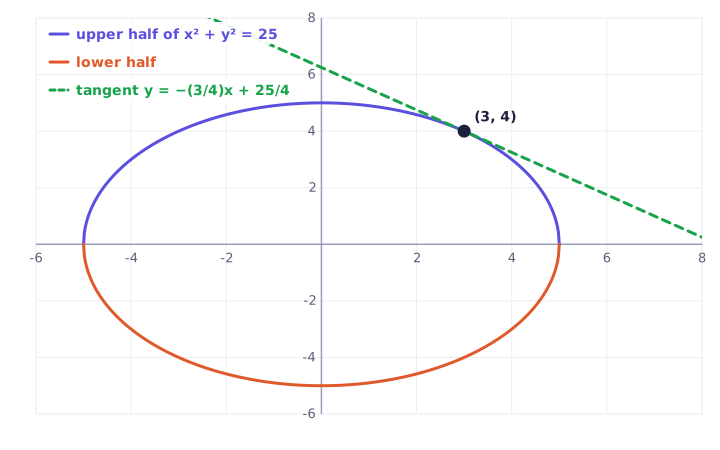
Implicit differentiation finds slopes on curves. Differentiate both sides with respect to x. Every time you differentiate a y term, multiply by \frac{dy}{dx}. Then solve for \frac{dy}{dx}.
Inverse functions flip the slope. If f and g are inverses, their graphs are reflections over y = x, so the slopes at matching points are reciprocals. See the inverse function rule.
Second derivatives come next. The second derivative f''(x) is the rate of change of f'(x). In Unit 4 it becomes acceleration and in Unit 5 it tells you about concavity.
Sample questions
1. Chain rule. \frac{d}{dx}\sin(x^3) = \cos(x^3)\cdot 3x^2 = 3x^2\cos(x^3).
2. Implicit differentiation. For x^2 + y^2 = 25, differentiate both sides:
At (3, 4) the slope is -\frac{3}{4}.
3. An implicit second derivative. Differentiate \frac{dy}{dx} = -\frac{x}{y} with the quotient rule and substitute:
4. Inverse function from a table. Let f(x) = x^3 + x and let g be its inverse. Since f(1) = 2 and f'(x) = 3x^2 + 1:
5. Inverse trig with the chain rule. \frac{d}{dx}\arctan(2x) = \frac{1}{1 + (2x)^2}\cdot 2 = \frac{2}{1 + 4x^2}.
How to study Unit 3
- Name the inside function out loud. Before you differentiate, say what the inside is. Most chain rule errors come from forgetting to multiply by its derivative.
- Simplify implicit second derivatives. After differentiating twice, substitute \frac{dy}{dx} back in and use the original equation to simplify, as in sample question 3.
- Practice inverse problems from tables. Find the row where f(a) = b first. Students often plug b into f' by mistake.
- Mix the rules. Real exam questions combine the chain rule with the product or quotient rule. Do mixed sets, not one rule at a time.
- Work through problem sets. Try the chain rule practice problems, implicit differentiation problems and inverse trig derivative problems, each with full solutions.
For the full course map, see the AP Calculus AB guide or the AP Calculus BC guide.
AP and Advanced Placement are registered trademarks of College Board, which is not affiliated with PracticeCalculus and does not endorse this guide. Unit names and weights come from College Board's course framework; check it for any changes.
Practice it now
Chain rule: any function
Solve real problems on this topic with instant feedback, hints and a step-by-step walkthrough for every answer. Free, no sign-up needed to start.
Practice this lesson