Limits at Infinity: End Behavior and Horizontal Asymptotes
Learn how to find limits at infinity: the degree rules for rational functions, horizontal asymptotes, square roots, and worked examples with graphs.
By the PracticeCalculus team Published 8 min read
On this page
- What is a limit at infinity?
- The building block: 1 over x to a power
- The method: divide by the highest power in the denominator
- The degree rules for rational functions
- Square roots: why the two ends can differ
- Infinity minus infinity: use the conjugate
- Limits at infinity vs infinite limits
- Other functions you should know
- Common mistakes with limits at infinity
- Practice reading end behavior
What happens to a function far out on the graph, past the edge of your calculator screen? Does it level off, shoot upward, or keep wobbling? Limits at infinity answer that question, and for rational functions there is a simple set of rules that settles almost every problem in seconds.
What is a limit at infinity?
A limit at infinity describes the value a function approaches as x grows without bound. We write
to mean that when x is large enough, f(x) stays as close to L as you like. Similarly, \lim_{x \to -\infty} f(x) describes what happens as x becomes very negative.
Together these two limits describe the end behavior of a function: what the graph does at its far left and far right.
There are three possible outcomes:
- The outputs approach a number L. Then the line y = L is a horizontal asymptote.
- The outputs grow without bound, and we write \infty or -\infty.
- The outputs never settle, like \sin x, which keeps oscillating. Then the limit does not exist.
The building block: 1 over x to a power
Everything below rests on one fact. For any positive power p,
Dividing a fixed number by an enormous number gives something tiny. \frac{1}{1000} is small, \frac{1}{1000^2} is smaller still. The same holds as x \to -\infty whenever x^p is defined there.
More generally, \frac{c}{x^p} \to 0 for any constant c. The strategy for complicated expressions is to rewrite them so every leftover piece looks like \frac{c}{x^p}.
The method: divide by the highest power in the denominator
For a rational function, divide every term in the numerator and denominator by the highest power of x that appears in the denominator. Then let each \frac{c}{x^p} term go to 0.
Worked example 1: equal degrees
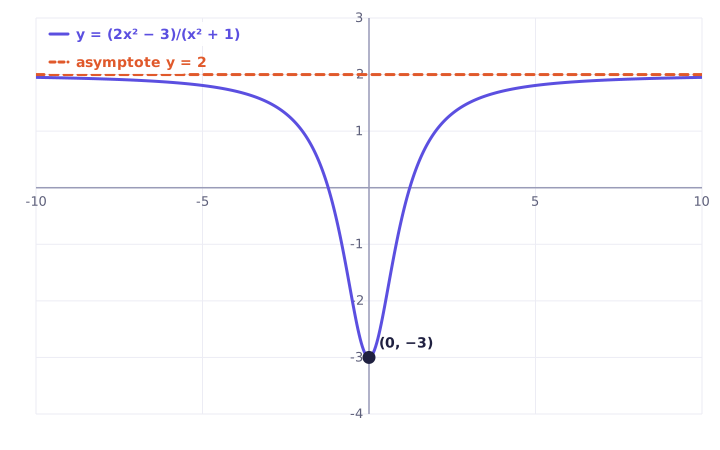
Find \lim_{x \to \infty} \frac{2x^2 - 3}{x^2 + 1}.
Step 1. Find the highest power in the denominator. It is x^2.
Step 2. Divide every term by x^2.
Step 3. Let the small terms vanish. As x \to \infty, \frac{3}{x^2} \to 0 and \frac{1}{x^2} \to 0:
The same steps give 2 as x \to -\infty, so y = 2 is a horizontal asymptote on both ends.
Worked example 2: bottom-heavy
Find \lim_{x \to \infty} \frac{5x + 2}{x^2 + 1}.
Step 1. The highest power in the denominator is x^2.
Step 2. Divide every term by x^2.
Step 3. Take the limit. The top goes to 0 + 0 = 0 and the bottom to 1:
So y = 0 is a horizontal asymptote. Notice this graph actually crosses y = 0 at x = -\frac{2}{5}. That is allowed: an asymptote only describes the far ends.
Worked example 3: top-heavy
Find \lim_{x \to \infty} \frac{x^3 - 1}{2x + 5}.
Step 1. The highest power in the denominator is x.
Step 2. Divide every term by x.
Step 3. Take the limit. The bottom goes to 2, but the top contains x^2, which grows without bound:
There is no horizontal asymptote. For large x the function behaves like \frac{x^3}{2x} = \frac{x^2}{2}, a parabola.
The degree rules for rational functions
Once you have done a few examples, you will notice that only the leading terms matter. For
with n the degree of the top and m the degree of the bottom:
| Degrees | \lim_{x \to \pm\infty} f(x) | Horizontal asymptote |
|---|---|---|
| n < m (bottom bigger) | 0 | y = 0 |
| n = m (equal) | \frac{a}{b} | y = \frac{a}{b} |
| n > m (top bigger) | \pm\infty | none |
When n > m, the sign of the infinity comes from the leading terms: \frac{a x^n}{b x^m} = \frac{a}{b} x^{n-m}. Check the sign of that for large positive or large negative x.
Tip: if n = m + 1, the graph has a slant (oblique) asymptote instead. Polynomial division of the top by the bottom gives the line.
Square roots: why the two ends can differ
Rational functions always have the same horizontal asymptote on both ends. Square roots can break that symmetry, because
which equals x when x > 0 but -x when x < 0.
Worked example 4: a root in the numerator
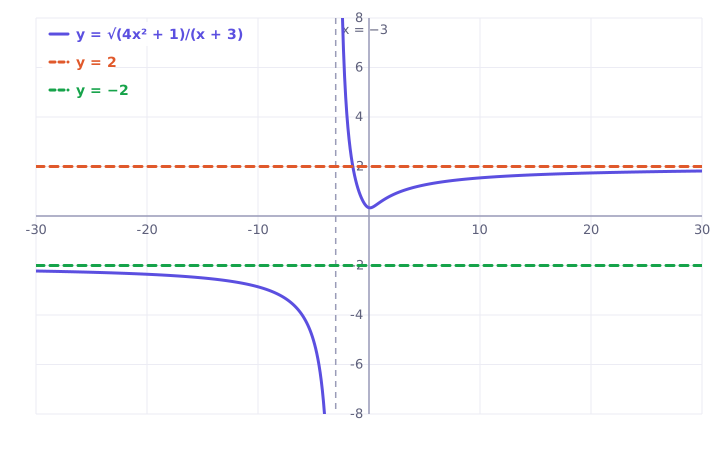
Find both \lim_{x \to \infty} and \lim_{x \to -\infty} of f(x) = \frac{\sqrt{4x^2 + 1}}{x + 3}.
Step 1. Factor x^2 out of the root.
Step 2. As x \to \infty, |x| = x. Divide top and bottom by x:
Step 3. As x \to -\infty, |x| = -x. Now the same division gives an extra minus sign:
Step 4. State the asymptotes. y = 2 on the right and y = -2 on the left. (There is also a vertical asymptote at x = -3, where the denominator is 0.)
Infinity minus infinity: use the conjugate
Some limits at infinity are not fractions at all. A difference of two growing terms gives the form \infty - \infty, which is indeterminate: the answer depends on which term grows faster, and by how much.
Worked example 5: a difference with a root
Find \lim_{x \to \infty} \left(\sqrt{x^2 + x} - x\right).
Step 1. Identify the form. Both \sqrt{x^2 + x} and x grow without bound, so this is \infty - \infty. You cannot conclude anything yet.
Step 2. Multiply by the conjugate over itself.
Step 3. Divide top and bottom by x. For x > 0, \frac{\sqrt{x^2 + x}}{x} = \sqrt{1 + \frac{1}{x}}, so
Step 4. Take the limit.
So the two terms do not cancel to 0. The root is always about \frac{1}{2} ahead of x.
Limits at infinity vs infinite limits
These two phrases sound alike but describe different things, and mixing them up is common.
- A limit at infinity has x \to \pm\infty. It describes end behavior and gives horizontal asymptotes. Example: \lim_{x \to \infty} \frac{1}{x} = 0.
- An infinite limit has the output going to \pm\infty as x approaches a finite number. It gives vertical asymptotes. Example: \lim_{x \to 0^+} \frac{1}{x} = \infty.
A single function can have both, as worked example 4 shows: horizontal asymptotes y = \pm 2 and a vertical asymptote at x = -3.
Other functions you should know
Not every limit at infinity involves a fraction of polynomials. These come up constantly:
| Limit | Value | Why |
|---|---|---|
| \lim_{x \to \infty} e^{-x} | 0 | e^{-x} = \frac{1}{e^x} and e^x grows without bound |
| \lim_{x \to -\infty} e^{x} | 0 | Same fact viewed from the left |
| \lim_{x \to \infty} \ln x | \infty | Slowly, but without bound |
| \lim_{x \to \infty} \arctan x | \frac{\pi}{2} | Horizontal asymptote y = \frac{\pi}{2} |
| \lim_{x \to -\infty} \arctan x | -\frac{\pi}{2} | Horizontal asymptote y = -\frac{\pi}{2} |
| \lim_{x \to \infty} \frac{\sin x}{x} | 0 | Squeeze: -\frac{1}{x} \le \frac{\sin x}{x} \le \frac{1}{x} |
| \lim_{x \to \infty} \sin x | does not exist | Oscillates forever |
It also helps to know the growth hierarchy for large x: logarithms grow slower than any positive power of x, and powers grow slower than exponentials. So \frac{\ln x}{x} \to 0 and \frac{x^{10}}{e^x} \to 0. You can prove these with L'Hôpital's rule.
Common mistakes with limits at infinity
- Dividing by the wrong power. Divide by the highest power in the denominator. Dividing by something smaller leaves a term that still grows, and the limit stays hidden.
- Treating \frac{\infty}{\infty} as 1. It is indeterminate. \frac{x^2}{x} and \frac{x}{x^2} are both \frac{\infty}{\infty} but have limits \infty and 0.
- Treating \infty - \infty as 0. Worked example 5 shows the answer can be any number, in that case \frac{1}{2}.
- Forgetting \sqrt{x^2} = |x|. This is the classic source of a wrong sign as x \to -\infty.
- Believing graphs never cross asymptotes. Vertical asymptotes cannot be crossed, but horizontal ones often are.
Practice reading end behavior
The degree rules take a minute to learn and a few dozen problems to trust. In the interactive lesson below you will predict end behavior, find horizontal asymptotes, and get instant feedback that points out exactly which power or sign you missed. Once these become automatic, curve sketching and continuity questions get much easier too.
Practice it now
Limits at infinity
Solve real problems on this topic with instant feedback, hints and a step-by-step walkthrough for every answer. Free, no sign-up needed to start.
Practice this lesson