Derivative of e^(−x): Formula, Steps and Examples
The derivative of e^(−x) is −e^(−x). See the chain rule steps, a check with the quotient rule, higher derivatives, a graph and examples like xe^(−x).
Exponential and log derivatives Updated 2 min read
At a glance
- Derivative
- -e^{-x}
- Second derivative
- e^{-x}
- nth derivative
- (-1)^n e^{-x}
- Same function as
- \dfrac{1}{e^x}
- Integral version
- \int e^{-x}\,dx = -e^{-x} + C
On this page
The derivative of e^{-x} is -e^{-x}. The exponential stays the same, and the derivative of the exponent -x, which is -1, puts a minus sign in front.
Step by step with the chain rule
Think of e^{-x} as e^u with u = -x. The chain rule gives
The outer step uses the fact that the derivative of eˣ is e^x.
Check with the quotient rule
Since e^{-x} = \frac{1}{e^x}, the quotient rule should agree:
Same answer, with more work. The chain rule is the quick way.
Graph of e^(−x) and its derivative
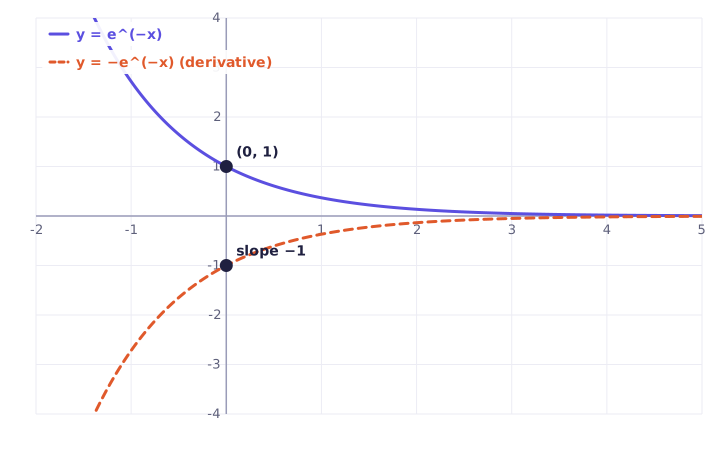
The graph of e^{-x} is the graph of e^x reflected across the y-axis. Reflecting left to right turns every rising slope into a falling one, so the derivative is negative. As x \to \infty both the function and its slope shrink toward 0. This is the shape of exponential decay.
Higher derivatives
Each derivative brings out another -1, so the signs alternate:
| Derivative | Result |
|---|---|
| f'(x) | -e^{-x} |
| f''(x) | e^{-x} |
| f'''(x) | -e^{-x} |
| f^{(n)}(x) | (-1)^n e^{-x} |
Since f''(x) = f(x), the function e^{-x} solves the differential equation y'' = y, just like e^x does. And f'(x) = -f(x) says it shrinks at a rate equal to its own size, which is the defining rule of exponential decay.
Worked examples
Example 1: product rule. For f(x) = xe^{-x}, the product rule gives
So f rises for x < 1, falls for x > 1, and has a maximum of f(1) = \frac{1}{e} \approx 0.368.
Example 2: exponential decay. A quantity A(t) = 50e^{-0.2t} changes at the rate
At t = 0 it is falling by 10 units per unit time.
Example 3: a sum. For g(x) = e^x + e^{-x},
Divide both by 2 and you get the derivative of cosh x, which is \sinh x.
Common mistakes
- Dropping the minus sign. \frac{d}{dx}e^{-x} = e^{-x} is wrong. The inside derivative is -1.
- Writing -xe^{-x - 1}. That uses the power rule on an exponential.
- Losing track of signs in higher derivatives. Even derivatives are positive, odd ones are negative.
- Getting the integral sign wrong. \int e^{-x}\,dx = -e^{-x} + C, not e^{-x} + C. See the integral of e^(−x).
For more chain rule practice with exponentials, try derivatives of exponential and logarithmic functions.
Practice it now
Chain rule: e and ln
Solve real problems on this topic with instant feedback, hints and a step-by-step walkthrough for every answer. Free, no sign-up needed to start.
Practice this lesson