Derivative of sin x: Formula, Proof and Examples
The derivative of sin x is cos x. See the limit proof, the chain rule version for sin(u), a graph and worked examples like sin(3x) and x sin x.
Trigonometric derivatives Updated 2 min read
At a glance
- Derivative
- \cos x for every real x
- Chain rule form
- \dfrac{d}{dx}\sin u = \cos u \cdot u'
- Second derivative
- -\sin x
- Units
- x must be in radians
- Integral version
- \int \sin x\,dx = -\cos x + C
On this page
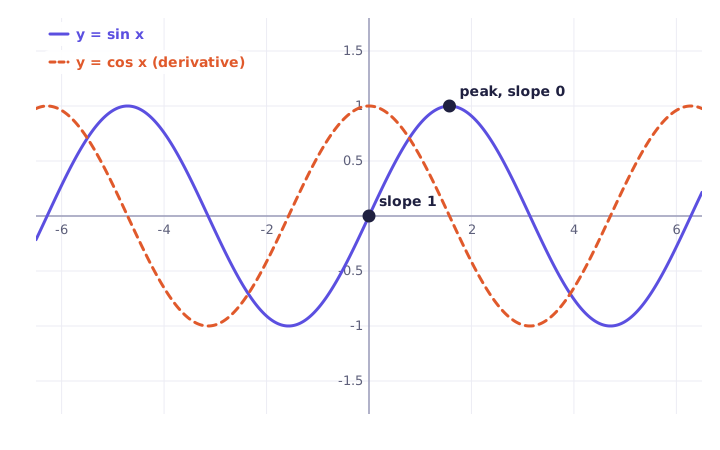
The derivative of \sin x is \cos x. Wherever the sine wave is rising, cosine is positive. Wherever it is falling, cosine is negative.
Graph of sin x and its derivative
Proof from the limit definition
Use the angle sum formula \sin(x + h) = \sin x\cos h + \cos x\sin h:
Two standard limits finish it. As h \to 0, \frac{\sin h}{h} \to 1 (proved with the squeeze theorem) and \frac{\cos h - 1}{h} \to 0. So
The limit \frac{\sin h}{h} \to 1 only holds with h in radians. That is the real reason calculus uses radians.
The chain rule version: derivative of sin(u)
Keep the inside the same, change sine to cosine, then multiply by the inside's derivative. See the chain rule.
| Function | Inside u | Derivative |
|---|---|---|
| \sin(3x) | 3x | 3\cos(3x) |
| \sin(2x) | 2x | 2\cos(2x) |
| \sin(x^2) | x^2 | 2x\cos(x^2) |
| \sin(e^x) | e^x | e^x\cos(e^x) |
| \sin\left(\frac{x}{2}\right) | \frac{x}{2} | \frac{1}{2}\cos\left(\frac{x}{2}\right) |
Full pages: derivative of sin 2x and derivative of sin(x²).
Worked examples
Example 1: a product. Differentiate f(x) = x\sin x with the product rule:
Example 2: a power of sine. \frac{d}{dx}\sin^3 x = 3\sin^2 x\cos x. The outer function is the cube, the inner is \sin x.
Example 3: a tangent line. At x = \frac{\pi}{3}, \sin\frac{\pi}{3} = \frac{\sqrt{3}}{2} and the slope is \cos\frac{\pi}{3} = \frac{1}{2}:
Example 4: higher derivatives. The derivatives of \sin x cycle every four steps: \cos x, -\sin x, -\cos x, then \sin x again. So the 10th derivative is the same as the 2nd: -\sin x.
Common mistakes
- Adding a minus sign. \frac{d}{dx}\sin x = \cos x, positive. The minus belongs to the derivative of cos x.
- Changing the inside. \frac{d}{dx}\sin(3x) is 3\cos(3x), not 3\cos x or \cos 3.
- Confusing \sin^2 x and \sin(x^2). Their derivatives are 2\sin x\cos x and 2x\cos(x^2).
- Working in degrees. In degrees an extra factor \frac{\pi}{180} appears.
The reverse is on the integral of sin x page. For a full overview, read derivatives of trig functions or try the trig derivative practice problems.
Practice it now
Sine, cosine and tangent
Solve real problems on this topic with instant feedback, hints and a step-by-step walkthrough for every answer. Free, no sign-up needed to start.
Practice this lesson