Derivative of x²: Formula, Proof and Examples
The derivative of x² is 2x. See the limit definition proof, the chain rule version for u², a graph, tangent lines and worked examples like (3x + 1)².
Powers, roots and polynomials Updated 2 min read
At a glance
- Derivative
- 2x for every real x
- Chain rule form
- \dfrac{d}{dx}\,u^2 = 2u\,u'
- Second derivative
- \dfrac{d^2}{dx^2}\,x^2 = 2
- Slope at x = 0
- 0, the bottom of the parabola
- Integral version
- \int x^2\,dx = \frac{x^3}{3} + C
On this page
The derivative of x^2 is 2x. This is usually the first derivative students compute by hand, and it shows the whole idea of a derivative in one line of algebra.
Graph of x² and its derivative
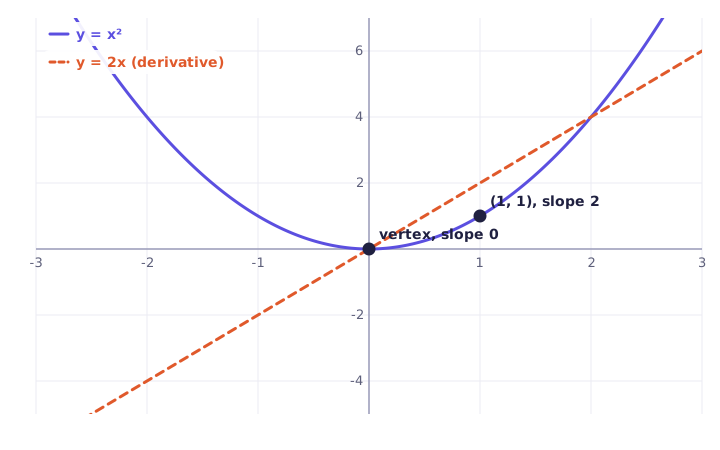
The derivative grows as x grows, so the parabola gets steeper the further you move from the vertex. That is what concave up looks like.
Proof from the limit definition
Start from
Expand the square: (x + h)^2 = x^2 + 2xh + h^2. The x^2 terms cancel:
You can also get it from the power rule, or from the product rule with x \cdot x: 1\cdot x + x \cdot 1 = 2x.
The chain rule version: derivative of u²
When something other than x is being squared, use the chain rule:
| Function | Inside u | Derivative 2u\,u' |
|---|---|---|
| (3x + 1)^2 | 3x + 1 | 6(3x + 1) |
| (x^2 + 5)^2 | x^2 + 5 | 4x(x^2 + 5) |
| \sin^2 x | \sin x | 2\sin x\cos x |
| (\ln x)^2 | \ln x | \frac{2\ln x}{x} |
The third row is worked out fully on the derivative of sin²x page.
Worked examples
Example 1: a polynomial. Differentiate f(x) = 4x^2 - 3x + 8:
Example 2: a tangent line. Find the tangent to y = x^2 at x = 3. The point is (3, 9) and the slope is 2(3) = 6:
Example 3: where is the slope 5? Solve 2x = 5 to get x = \frac{5}{2}. The point on the parabola is \left(\frac{5}{2}, \frac{25}{4}\right).
Example 4: second derivative. \frac{d}{dx}(2x) = 2, so \frac{d^2}{dx^2}x^2 = 2. A positive constant second derivative means the parabola bends upward everywhere.
Common mistakes
- Writing 2x^2. The exponent must drop by one: 2x^1 = 2x.
- Mixing up x^2 and 2^x. They look alike but 2^x is an exponential. Its derivative is 2^x \ln 2, see the derivative of 2ˣ.
- Dropping u'. \frac{d}{dx}(5x - 2)^2 = 10(5x - 2), not 2(5x - 2).
- Squaring the derivative. \frac{d}{dx}(x^2) is not \left(\frac{d}{dx}x\right)^2 = 1.
Going backward, \int x^2\,dx = \frac{x^3}{3} + C is on the integral of x² page. Practice more with the power rule problems.
Practice it now
The power rule
Solve real problems on this topic with instant feedback, hints and a step-by-step walkthrough for every answer. Free, no sign-up needed to start.
Practice this lesson