Arctangent arctan(x): Graph, Asymptotes, Derivative and Integral
The arctangent function arctan(x), the inverse of tangent: domain all reals, range (−π/2, π/2), graph, derivative 1/(1+x²), integral and examples.
Inverse trigonometric functions Updated 3 min read
At a glance
- Domain
- (-\infty, \infty)
- Range
- \left(-\frac{\pi}{2}, \frac{\pi}{2}\right)
- Derivative
- \frac{1}{1 + x^2}
- Integral
- x\arctan x - \frac{1}{2}\ln(1 + x^2) + C
- Horizontal asymptotes
- y = \pm\frac{\pi}{2}
- Symmetry
- Odd: \arctan(-x) = -\arctan x
On this page
The arctangent function undoes tangent: \arctan x is the angle in \left(-\frac{\pi}{2}, \frac{\pi}{2}\right) whose tangent is x. Unlike arcsine and arccosine, it accepts every real number, because tangent takes every real value. In calculus it is famous as the antiderivative of \frac{1}{1+x^2}.
Definition of arctan x
Since \tan y is the slope of a line at angle y, you can think of \arctan m as the angle a line of slope m makes with the positive x-axis. For example \arctan 1 = \frac{\pi}{4}: a line of slope 1 makes a 45 degree angle.
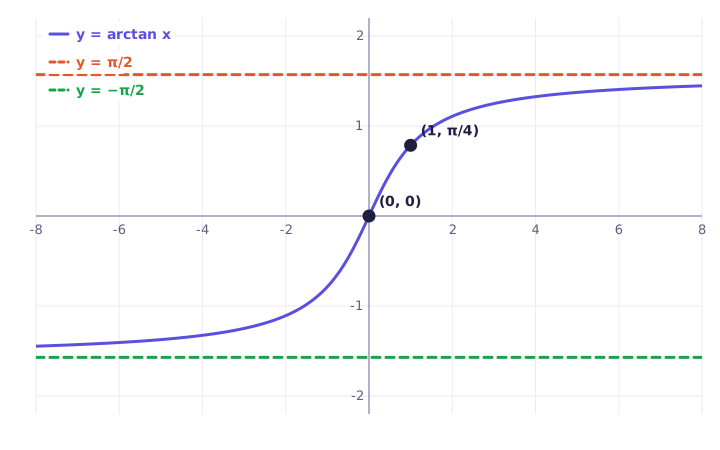
Graph of y = arctan x
Key values of arctangent
| x | -\sqrt{3} | -1 | -\frac{\sqrt{3}}{3} | 0 | \frac{\sqrt{3}}{3} | 1 | \sqrt{3} |
|---|---|---|---|---|---|---|---|
| \arctan x | -\frac{\pi}{3} | -\frac{\pi}{4} | -\frac{\pi}{6} | 0 | \frac{\pi}{6} | \frac{\pi}{4} | \frac{\pi}{3} |
Properties of arctangent
- Domain all reals, range \left(-\frac{\pi}{2}, \frac{\pi}{2}\right). The endpoints are never reached.
- Increasing and odd. \arctan(-x) = -\arctan x.
- Limits at infinity. \lim_{x\to\infty}\arctan x = \frac{\pi}{2} and \lim_{x\to-\infty}\arctan x = -\frac{\pi}{2}. See limits at infinity.
- Cancellation. \tan(\arctan x) = x for all x; \arctan(\tan x) = x only for x in \left(-\frac{\pi}{2}, \frac{\pi}{2}\right).
- Reciprocal identity. For x > 0, \arctan x + \arctan\frac{1}{x} = \frac{\pi}{2}.
Derivative of arctan x
Why. Let y = \arctan x, so \tan y = x. Implicit differentiation gives \sec^2 y\cdot y' = 1, so y' = \frac{1}{\sec^2 y} = \frac{1}{1 + \tan^2 y} = \frac{1}{1 + x^2}.
The derivative is always positive and largest at x = 0, where it equals 1. It shrinks toward 0 as |x| grows, matching how the graph flattens.
Integrals involving arctangent
These appear whenever an irreducible quadratic sits in a denominator, which is common in partial fractions.
The integral of arctangent itself uses integration by parts with u = \arctan x, dv = dx:
No absolute value is needed because 1 + x^2 > 0.
Worked examples
Example 1: chain rule. Differentiate f(x) = \arctan(2x):
Example 2: an improper integral.
This is a classic convergent improper integral.
Example 3: completing the square. Evaluate \int\frac{dx}{x^2 + 2x + 5}. Write x^2 + 2x + 5 = (x+1)^2 + 4 and use a = 2:
Example 4: a definite integral. \int_0^1\frac{dx}{1+x^2} = \arctan 1 - \arctan 0 = \frac{\pi}{4}.
Common mistakes
- Writing the derivative as \frac{1}{\sqrt{1+x^2}}. There is no square root for arctangent. The square root belongs to arcsine and arccosine (with 1 - x^2).
- Forgetting the \frac{1}{a}. \int\frac{dx}{9 + x^2} = \frac{1}{3}\arctan\frac{x}{3} + C, not \arctan\frac{x}{3} + C.
- Reading \tan^{-1}x as \cot x. \frac{1}{\tan x} is cotangent, a different function (see reciprocal trig functions).
- Answering outside the range. \arctan(-1) = -\frac{\pi}{4}, not \frac{3\pi}{4}.
How arctangent connects to other topics
The substitution x = a\tan\theta in trig substitution produces arctangent answers. Its power series, \arctan x = x - \frac{x^3}{3} + \frac{x^5}{5} - \cdots for |x| \le 1, comes from integrating the geometric series for \frac{1}{1+x^2}, and at x = 1 it gives the famous \frac{\pi}{4} = 1 - \frac{1}{3} + \frac{1}{5} - \cdots.
Practice it now
Trig substitution
Solve real problems on this topic with instant feedback, hints and a step-by-step walkthrough for every answer. Free, no sign-up needed to start.
Practice this lesson