Quadratic Function: Graph, Vertex, Derivative and Integral
The quadratic function f(x) = ax² + bx + c: parabola graph, vertex formula, roots, derivative 2ax + b, integral and worked calculus examples.
Algebraic functions Updated 3 min read
At a glance
- Domain
- (-\infty, \infty)
- Range
- \left[f\left(-\frac{b}{2a}\right), \infty\right) if a > 0
- Derivative
- 2ax + b
- Integral
- \frac{a}{3}x^3 + \frac{b}{2}x^2 + cx + C
- Vertex
- x = -\frac{b}{2a}
- Roots
- x = \frac{-b \pm \sqrt{b^2 - 4ac}}{2a}
On this page
A quadratic function is a polynomial of degree two. Its graph is a parabola, a symmetric U-shaped curve with a single turning point called the vertex. Quadratics model projectile height, area and profit, and they are the first curves where derivatives reveal something you cannot see from a line.
Formula and forms
| Form | Equation | Shows |
|---|---|---|
| Standard | ax^2 + bx + c | y-intercept c |
| Vertex | a(x - h)^2 + k | vertex (h, k) |
| Factored | a(x - r_1)(x - r_2) | roots r_1, r_2 |
Graph of a quadratic function
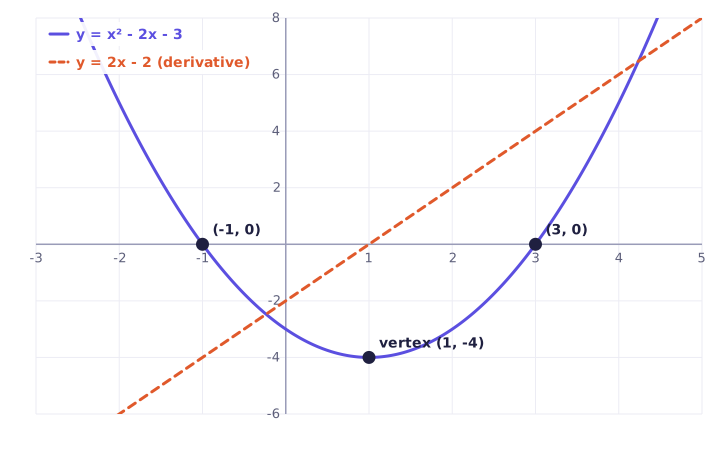
Key features:
- Direction. Opens up if a > 0 (vertex is a minimum), down if a < 0 (vertex is a maximum).
- Axis of symmetry. The vertical line x = -\frac{b}{2a}.
- Roots. From the quadratic formula x = \frac{-b \pm \sqrt{b^2 - 4ac}}{2a}. The discriminant b^2 - 4ac tells you whether there are two, one or no real roots.
- Range. \left[k, \infty\right) if a > 0 and \left(-\infty, k\right] if a < 0, where k is the vertex height.
Derivative of a quadratic
By the power rule and the sum rule:
The derivative of a quadratic is a linear function. It is zero at exactly one point, x = -\frac{b}{2a}, which is the vertex. The second derivative is the constant 2a, so the parabola is concave up everywhere when a > 0 and concave down everywhere when a < 0. That is why the vertex is always the absolute extremum.
Integral of a quadratic
The lowercase c is the quadratic's constant term; the uppercase C is the constant of integration.
Worked examples
Example 1: vertex with calculus. For f(x) = x^2 - 2x - 3, f'(x) = 2x - 2 = 0 gives x = 1, and f(1) = -4. The vertex is (1, -4), a minimum because a = 1 > 0.
Example 2: maximum height. A ball's height is h(t) = -5t^2 + 20t + 1 meters. Then h'(t) = -10t + 20 = 0 at t = 2, and the maximum height is h(2) = -20 + 40 + 1 = 21 meters.
Example 3: area under a parabola. Evaluate \int_0^3 (x^2 + 1)\,dx:
Example 4: tangent line. For f(x) = x^2 - 2x - 3 at x = 3: f(3) = 0 and f'(3) = 4, so the tangent line is y = 4(x - 3) = 4x - 12.
Common mistakes
- Forgetting the minus sign in -\frac{b}{2a}. For x^2 - 2x - 3, b = -2, so the vertex is at x = -\frac{-2}{2} = 1.
- Differentiating ax^2 as ax. The exponent comes down: \frac{d}{dx}3x^2 = 6x.
- Integrating x^2 as \frac{x^3}{2}. Divide by the new exponent, 3.
- Expanding (x - 2)^2 as x^2 + 4. The correct expansion is x^2 - 4x + 4.
How it connects
Quadratics are the simplest polynomial functions with curvature, so they are the standard first examples for optimization problems, curve sketching and area between curves. The second-degree Taylor polynomial of any smooth function is a quadratic, which is why parabolas approximate so many curves near a point.
Practice it now
The power rule
Solve real problems on this topic with instant feedback, hints and a step-by-step walkthrough for every answer. Free, no sign-up needed to start.
Practice this lesson