Integral of e^(2x): Formula, Steps and Examples
The integral of e^(2x) is ½e^(2x) + C, and in general ∫e^(kx) dx = (1/k)e^(kx) + C. See the substitution, a graph and worked examples.
Exponential and log integrals Updated 2 min read
At a glance
- Antiderivative
- \frac{1}{2}e^{2x} + C
- General form
- \int e^{kx}\,dx = \frac{1}{k}e^{kx} + C for k \ne 0
- Method
- Substitution u = 2x, du = 2\,dx
- From 0 to 1
- \frac{e^2 - 1}{2} \approx 3.195
On this page
The integral of e^{2x} is \dfrac{1}{2}e^{2x} + C. More generally, to integrate e^{kx} you keep the exponential and divide by k.
Graph of e²ˣ and its antiderivative
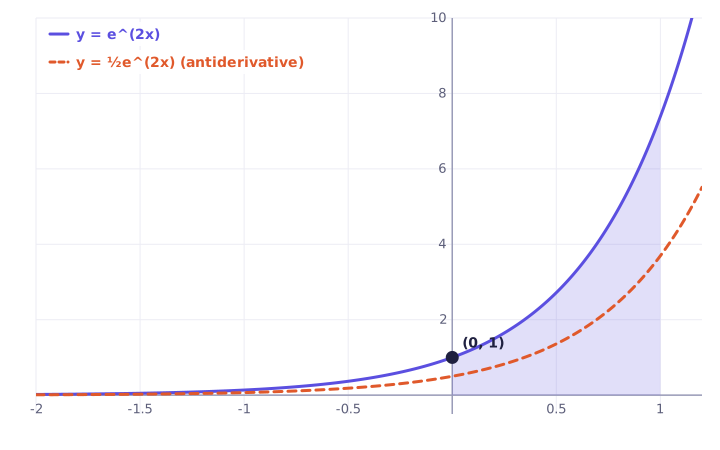
How to integrate e²ˣ step by step
Use u-substitution.
- Let u = 2x. Then du = 2\,dx, so dx = \frac{1}{2}\,du.
- Rewrite: \displaystyle\int e^{2x}\,dx = \int e^u\cdot\frac{1}{2}\,du = \frac{1}{2}\int e^u\,du.
- Integrate: \frac{1}{2}e^u + C, using the integral of eˣ.
- Substitute back: \frac{1}{2}e^{2x} + C.
The same steps with u = kx give \frac{1}{k}e^{kx} + C. With a constant added, u = kx + b, you get \frac{1}{k}e^{kx + b} + C.
Another way to see it. The rule "divide by the inside slope" works for every linear inside: \int\cos(3x)\,dx = \frac{1}{3}\sin 3x, \int (2x+1)^5\,dx = \frac{1}{12}(2x+1)^6. It is the reverse of the chain rule multiplying by the inside slope.
Check by differentiating
The chain rule brings out a factor k, and the \frac{1}{k} cancels it. See the derivative of e²ˣ for the forward direction.
Definite integrals
| Integral | Work | Value |
|---|---|---|
| \int_0^1 e^{2x}\,dx | \frac{1}{2}(e^2 - 1) | \approx 3.195 |
| \int_0^{\ln 3} e^{2x}\,dx | \frac{1}{2}(9 - 1) | 4 |
| \int_{-\infty}^{0} e^{2x}\,dx | \frac{1}{2}(1 - 0) | \frac{1}{2} |
| \int_0^{\infty} e^{-3x}\,dx | -\frac{1}{3}(0 - 1) | \frac{1}{3} |
In the second row, e^{2\ln 3} = (e^{\ln 3})^2 = 9. The last row is an example of a useful fact: \int_0^\infty e^{-kx}\,dx = \frac{1}{k} for k > 0.
Worked examples
Example 1: a shifted exponent. \displaystyle\int e^{3x + 1}\,dx = \frac{1}{3}e^{3x+1} + C.
Example 2: a fraction in the exponent. \displaystyle\int e^{x/2}\,dx = 2e^{x/2} + C, since k = \frac{1}{2}.
Example 3: expand first. \displaystyle\int (e^x + 1)^2\,dx. Expand to e^{2x} + 2e^x + 1:
Example 4: simplify a quotient. \displaystyle\int \frac{e^{5x}}{e^{3x}}\,dx = \int e^{2x}\,dx = \frac{1}{2}e^{2x} + C.
Example 5: growth. A population grows at a rate r(t) = 100e^{0.2t} per year. The increase over the first 5 years is
Common mistakes
- Multiplying instead of dividing. \int e^{2x}\,dx is not 2e^{2x}. That is the derivative.
- Dividing by 2x. The divisor must be a constant. If the exponent is not linear, the shortcut fails.
- Applying it to e^{x^2}. \int e^{x^2}\,dx has no elementary antiderivative. See the integral of e^(x²).
- Sign slips with negative k. \int e^{-2x}\,dx = -\frac{1}{2}e^{-2x} + C. See the integral of e⁻ˣ.
Practice it now
U-substitution
Solve real problems on this topic with instant feedback, hints and a step-by-step walkthrough for every answer. Free, no sign-up needed to start.
Practice this lesson