Integral of x²: Formula, Derivation and Examples
The integral of x² is x³/3 + C. See the reverse power rule, a Riemann sum proof, definite integrals, the (ax + b)² form and the mistakes students make.
Powers, roots and rational functions Updated 2 min read
At a glance
- Antiderivative
- \dfrac{x^3}{3} + C
- Rule used
- Reverse power rule with n = 2
- Area from 0 to b
- \dfrac{b^3}{3}
- Area from 0 to 1
- \dfrac{1}{3}
- Check
- \dfrac{d}{dx}\dfrac{x^3}{3} = x^2
On this page
The integral of x^2 is \dfrac{x^3}{3} + C. Add one to the exponent and divide by the new exponent.
Graph: the area under y = x²
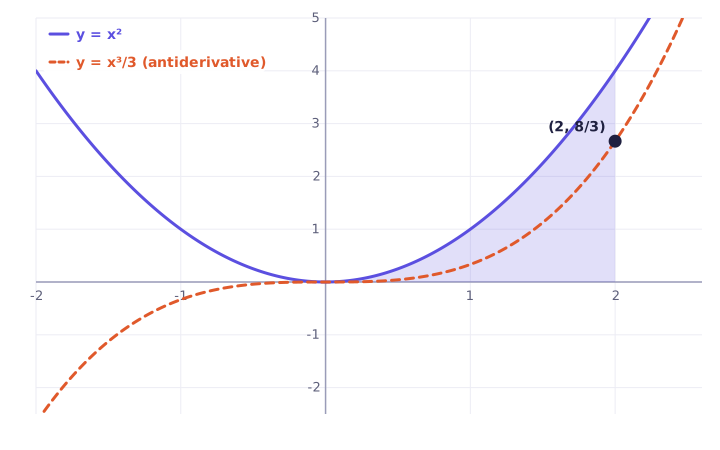
Notice that the antiderivative is flat at x = 0 (where x^2 = 0) and never decreases, because x^2 is never negative.
Derivation with the reverse power rule
- Start from the reverse power rule: \int x^n\,dx = \frac{x^{n+1}}{n+1} + C for n \ne -1.
- Set n = 2: the new exponent is 3.
- Divide by 3: \frac{x^3}{3}.
- Add C.
A proof from Riemann sums
You can also find the area under x^2 from 0 to b without knowing any antiderivative. Split [0, b] into n strips of width \frac{b}{n} and use right endpoints x_i = \frac{bi}{n}:
As n \to \infty, the fraction \frac{n(n+1)(2n+1)}{6n^3} tends to \frac{2}{6} = \frac{1}{3}, so the area is \frac{b^3}{3}. That matches the antiderivative. This is the same computation Archimedes did for the parabola, and you can practise it on the Riemann sums guide.
Check by differentiating
See also the derivative of x².
Substitution variant: integral of (ax + b)²
With u = ax + b and du = a\,dx:
For example, \int (2x + 1)^2\,dx = \frac{(2x + 1)^3}{6} + C. Check: the derivative is \frac{3(2x+1)^2\cdot 2}{6} = (2x + 1)^2.
The same idea handles an extra factor of x: \int x(x^2 + 1)^2\,dx = \frac{(x^2 + 1)^3}{6} + C, using u = x^2 + 1. More on this on the u-substitution rule page.
Worked examples
Example 1. \int_1^3 x^2\,dx = \frac{27}{3} - \frac{1}{3} = \frac{26}{3}.
Example 2. \int (x^2 + 3x - 2)\,dx = \frac{x^3}{3} + \frac{3x^2}{2} - 2x + C.
Example 3. \int_{-2}^{2} x^2\,dx = \frac{8}{3} - \left(-\frac{8}{3}\right) = \frac{16}{3}. Since x^2 is even, this is twice \int_0^2 x^2\,dx.
Example 4: volume. Spinning y = x around the x-axis on [0, h] gives a cone with volume \pi\int_0^h x^2\,dx = \frac{\pi h^3}{3}, the familiar \frac{1}{3}\pi r^2 h with r = h.
Common mistakes
- Writing 2x. That is the derivative, not the integral.
- Forgetting to divide by 3. x^3 has derivative 3x^2, not x^2.
- Integrating (2x + 1)^2 as \frac{(2x+1)^3}{3}. You must also divide by the inside derivative, 2.
- Squaring the integral of x. Integrals do not distribute over products.
Practice with the antiderivative problems and definite integral problems.
Practice it now
The reverse power rule
Solve real problems on this topic with instant feedback, hints and a step-by-step walkthrough for every answer. Free, no sign-up needed to start.
Practice this lesson