Linearity of Integrals: Sum, Difference and Constant Multiple Rules
The integral linearity rules: integrate sums term by term and pull constants out. Formulas, examples and the mistakes to avoid with products and quotients.
Integration rules Updated 3 min read
At a glance
- Sum rule
- \int (f + g)\,dx = \int f\,dx + \int g\,dx
- Difference rule
- \int (f - g)\,dx = \int f\,dx - \int g\,dx
- Constant multiple rule
- \int k\,f(x)\,dx = k\int f(x)\,dx for any constant k
- Does not apply to
- Products and quotients: \int f g\,dx \ne \int f\,dx \cdot \int g\,dx
- Holds for
- Both indefinite and definite integrals
On this page
The linearity rules say that integration respects addition and scaling. You can split a sum into separate integrals and move constant factors outside the integral sign. Together with the reverse power rule, they let you integrate any polynomial in one line.
The linearity rules
For integrable functions f and g and constants a and b:
This single statement contains three rules:
- Sum rule: \int (f + g)\,dx = \int f\,dx + \int g\,dx
- Difference rule: \int (f - g)\,dx = \int f\,dx - \int g\,dx
- Constant multiple rule: \int k\,f(x)\,dx = k\int f(x)\,dx
The same rules hold for definite integrals over the same interval:
Why linearity works
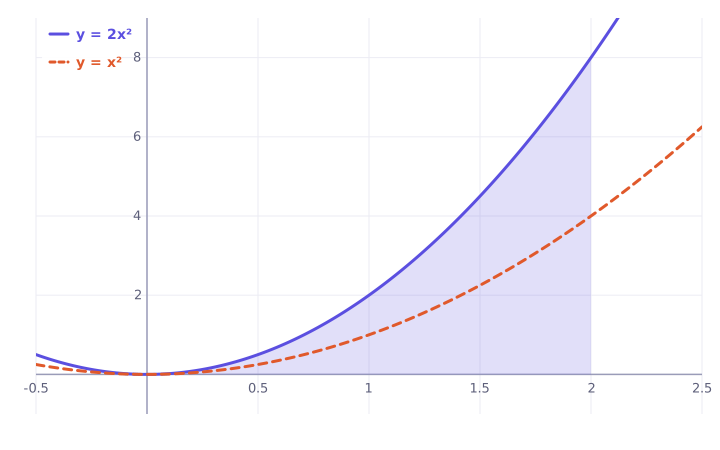
Differentiation is linear: \frac{d}{dx}[aF + bG] = aF' + bG'. If F' = f and G' = g, then aF + bG is an antiderivative of af + bg, which is exactly the rule. For definite integrals the reason is even more visual: a Riemann sum of f + g is the sum of the Riemann sums of f and g, and stretching a graph by k stretches every rectangle, and so the area, by k.
Worked examples
Example 1: a polynomial. Split, pull out constants, then apply the reverse power rule to each piece:
Example 2: mixed function types. Linearity lets you combine rules from different families:
Example 3: split a quotient first. There is no quotient rule for integrals, but you can divide each term by the denominator:
Example 4: a definite integral. Using known values \int_0^1 f(x)\,dx = 4 and \int_0^1 g(x)\,dx = -1:
What linearity does not do
Linearity covers sums and constant multiples only. These are all false in general:
| Tempting but wrong | Why |
|---|---|
| \int f g\,dx = \int f\,dx \cdot \int g\,dx | No product rule for integrals |
| \int \frac{f}{g}\,dx = \frac{\int f\,dx}{\int g\,dx} | No quotient rule for integrals |
| \int x\,f(x)\,dx = x\int f(x)\,dx | x is not a constant |
| \int \frac{1}{f(x)}\,dx = \frac{1}{\int f(x)\,dx} | Reciprocals do not pass through |
When the integrand is a product, try expanding it, then reach for u-substitution or integration by parts.
Common mistakes
- Moving the variable outside. Only constants come out. In \int 3x\sin x\,dx you may pull out the 3, not the x.
- Integrating a product factor by factor. \int x(x^2+1)\,dx must be expanded to \int (x^3 + x)\,dx = \frac{x^4}{4} + \frac{x^2}{2} + C.
- Splitting a denominator. \frac{1}{x + 1} \ne \frac{1}{x} + 1. You can split a fraction across terms in the numerator, never the denominator.
- Losing a sign in a difference. Distribute the minus sign to every term of the second integral.
The derivative counterparts are the constant multiple rule and the sum and difference rule. For more practice combining these rules, see the guide to antiderivatives.
Practice it now
Antiderivative practice
Solve real problems on this topic with instant feedback, hints and a step-by-step walkthrough for every answer. Free, no sign-up needed to start.
Practice this lesson