Mean Value Theorem (MVT): Statement, Graph and Examples
The mean value theorem: a smooth function on [a, b] has a point where the tangent slope equals the average slope. Statement, graph, counterexamples, examples.
Differential calculus theorems Updated 3 min read
At a glance
- Hypotheses
- f continuous on [a, b] and differentiable on (a, b)
- Conclusion
- Some c in (a, b) has f'(c) = \frac{f(b) - f(a)}{b - a}
- Geometric meaning
- Some tangent line is parallel to the secant line through the endpoints
- Physical meaning
- At some instant, instantaneous velocity equals average velocity
- Special case
- Rolle's theorem, when f(a) = f(b)
- Course
- Calculus 1
On this page
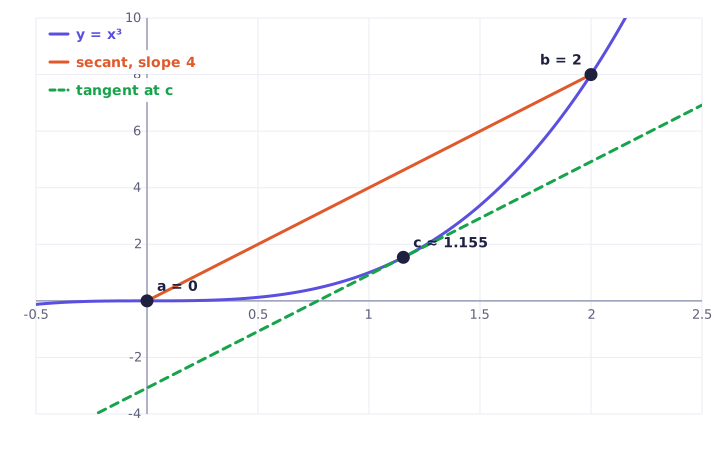
The mean value theorem (MVT) says that for a smooth function, the average rate of change over an interval is achieved as an instantaneous rate of change at some point inside it. Geometrically, some tangent line is parallel to the secant line joining the endpoints.
Statement of the mean value theorem
Let f satisfy both hypotheses:
- f is continuous on the closed interval [a, b];
- f is differentiable on the open interval (a, b).
Then there is at least one number c in (a, b) such that
Equivalently, f(b) - f(a) = f'(c)(b - a). This second form is the one used in proofs: it converts information about the derivative into information about the function.
What the MVT means
The fraction \frac{f(b) - f(a)}{b - a} is the slope of the secant line, the average rate of change. f'(c) is the slope of the tangent, an instantaneous rate of change. The MVT says the two agree somewhere. If your average speed on a trip was 60 mph, at some instant you were going exactly 60 mph.
Why each hypothesis matters
Differentiability. Take f(x) = |x| on [-1, 2]. It is continuous, and the secant slope is \frac{2 - 1}{2 - (-1)} = \frac{1}{3}. But f'(x) is -1 for x < 0 and 1 for x > 0, never \frac{1}{3}. The corner at 0 is the culprit.
Continuity. Take f(x) = \frac{1}{x} on [-1, 1]. The secant slope is \frac{1 - (-1)}{2} = 1, yet f'(x) = -\frac{1}{x^2} is always negative. The function is not continuous at 0, so the MVT does not apply.
Worked examples
Example 1: find c for f(x) = x^3 on [0, 2].
Step 1. f is a polynomial, so both hypotheses hold.
Step 2. Average slope: \frac{f(2) - f(0)}{2 - 0} = \frac{8}{2} = 4.
Step 3. Solve f'(c) = 3c^2 = 4, giving c = \pm\frac{2}{\sqrt{3}}. Only c = \frac{2}{\sqrt{3}} \approx 1.155 lies in (0, 2).
Example 2: find c for f(x) = \sqrt{x} on [1, 4].
f is continuous on [1, 4] and differentiable on (1, 4). The average slope is \frac{2 - 1}{4 - 1} = \frac{1}{3}. Solve
and \frac{9}{4} = 2.25 is in (1, 4).
Example 3: bounding a function. Suppose f(0) = 1 and f'(x) \le 3 for all x. How large can f(2) be?
By the MVT on [0, 2], f(2) - f(0) = f'(c) \cdot 2 for some c. Since f'(c) \le 3,
You learn something about f(2) without knowing the function. This is how the MVT is used in proofs and in linear approximation error estimates.
Key consequences
- Zero derivative means constant. If f'(x) = 0 on an interval, then for any two points f(x_2) - f(x_1) = 0 \cdot (x_2 - x_1) = 0, so f is constant.
- Same derivative means differ by a constant. If f' = g', then f - g is constant. This is why every antiderivative has a + C.
- Sign of f' gives monotonicity. If f' > 0 on an interval, f is increasing there, the basis of the first derivative test.
Common mistakes
- Answering with a c outside (a, b). Solve f'(c) = \text{slope}, then discard roots not in the open interval.
- Skipping the hypothesis check. For functions with roots, absolute values or fractions, check continuity and differentiability first.
- Thinking the MVT locates c. It only guarantees one exists. In many applications, as in Example 3, you never find c at all.
Related theorems
The MVT is proved from Rolle's theorem by subtracting the secant line from f. Its integral twin is the mean value theorem for integrals, and Taylor's theorem is a higher-order version. For more applications and practice, read the full mean value theorem guide.
Practice it now
Tangent lines at work
Solve real problems on this topic with instant feedback, hints and a step-by-step walkthrough for every answer. Free, no sign-up needed to start.
Practice this lesson