Derivative of arcsec x: Formula, Proof and Examples
The derivative of arcsec x is 1/(|x|√(x² − 1)). See where the absolute value comes from, a proof via arccos(1/x), and chain rule examples.
Inverse trig derivatives Updated 2 min read
At a glance
- Derivative
- \dfrac{1}{\lvert x\rvert\sqrt{x^2 - 1}} for \lvert x\rvert > 1
- Chain rule form
- \dfrac{d}{dx}\operatorname{arcsec} u = \dfrac{u'}{\lvert u\rvert\sqrt{u^2 - 1}}
- Domain of arcsec x
- x \le -1 or x \ge 1
- Range of arcsec x
- \left[0, \frac{\pi}{2}\right) \cup \left(\frac{\pi}{2}, \pi\right]
- Arccsc derivative
- -\dfrac{1}{\lvert x\rvert\sqrt{x^2 - 1}}
On this page
The derivative of \operatorname{arcsec} x is \dfrac{1}{\lvert x\rvert\sqrt{x^2 - 1}}. It is defined for \lvert x\rvert > 1, the same values where secant can output a number.
For x > 1, where most problems live, this is just \frac{1}{x\sqrt{x^2 - 1}}.
Graph of arcsec x
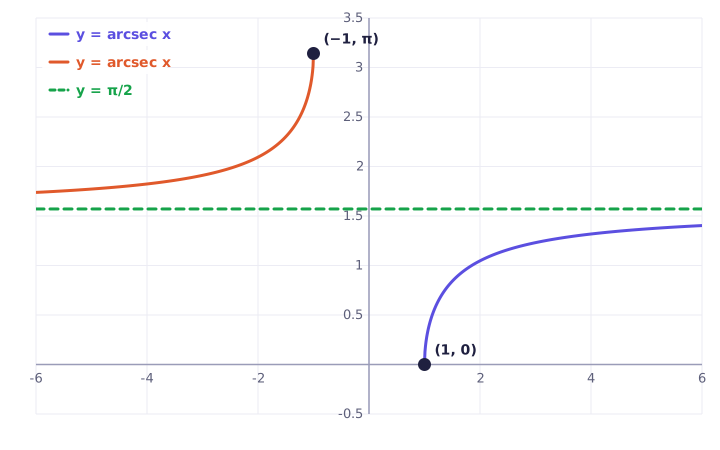
Both branches go upward from left to right, so the derivative is positive everywhere. That is exactly why the formula has \lvert x\rvert in it: without the absolute value, the formula would give negative slopes for x < -1, which does not match the picture.
Proof using arccos
The usual range of arcsec makes this identity true:
Differentiate with the chain rule and the derivative of arccos x:
Now simplify the root: \sqrt{1 - \frac{1}{x^2}} = \frac{\sqrt{x^2 - 1}}{\sqrt{x^2}} = \frac{\sqrt{x^2 - 1}}{\lvert x\rvert}. So
using x^2 = \lvert x\rvert^2. The absolute value appears naturally from \sqrt{x^2} = \lvert x\rvert.
Chain rule version and examples
Example 1. \frac{d}{dx}\operatorname{arcsec}(x^2) = \frac{2x}{x^2\sqrt{x^4 - 1}} = \frac{2}{x\sqrt{x^4 - 1}} for \lvert x\rvert > 1. Here \lvert x^2\rvert = x^2, so no absolute value is left.
Example 2. For x > 0, \frac{d}{dx}\operatorname{arcsec}(e^x) = \frac{e^x}{e^x\sqrt{e^{2x} - 1}} = \frac{1}{\sqrt{e^{2x} - 1}}.
Example 3: slope at a point. At x = 2, the slope of \operatorname{arcsec} x is \frac{1}{2\sqrt{3}} \approx 0.289. Since \operatorname{arcsec} 2 = \frac{\pi}{3}, the tangent line is y = \frac{\pi}{3} + \frac{1}{2\sqrt{3}}(x - 2).
The arccsc derivative
Since \operatorname{arcsec} x + \operatorname{arccsc} x = \frac{\pi}{2}, the derivatives are opposites:
Common mistakes
- Dropping the absolute value and then getting negative slopes for x < -1.
- Mixing textbook conventions. Check which range your course uses for arcsec before copying a formula.
- Confusing \sec^{-1} x with \cos x. \sec^{-1} is the inverse of secant, while \frac{1}{\sec x} = \cos x.
- Using it for -1 < x < 1. No angle has a secant between -1 and 1, so arcsec and its derivative do not exist there.
The formula also gives an integral: \int \frac{dx}{x\sqrt{x^2 - 1}} = \operatorname{arcsec}\lvert x\rvert + C. For more, see inverse trig derivative problems and the reciprocal trig functions.
Practice it now
Inverse trig derivatives
Solve real problems on this topic with instant feedback, hints and a step-by-step walkthrough for every answer. Free, no sign-up needed to start.
Practice this lesson