Arcsine arcsin(x): Graph, Domain, Range, Derivative and Integral
The arcsine function arcsin(x), the inverse of sine: domain [−1, 1], range [−π/2, π/2], graph, derivative 1/√(1−x²), integral and examples.
Inverse trigonometric functions Updated 3 min read
At a glance
- Domain
- [-1, 1]
- Range
- \left[-\frac{\pi}{2}, \frac{\pi}{2}\right]
- Derivative
- \frac{1}{\sqrt{1 - x^2}}
- Integral
- x\arcsin x + \sqrt{1 - x^2} + C
- Meaning
- The angle in \left[-\frac{\pi}{2}, \frac{\pi}{2}\right] whose sine is x
- Symmetry
- Odd: \arcsin(-x) = -\arcsin x
On this page
The arcsine function undoes the sine function: \arcsin x is the angle whose sine is x. Because sine repeats, it is not one-to-one, so arcsine picks the single answer in \left[-\frac{\pi}{2}, \frac{\pi}{2}\right]. In calculus it matters mostly as the antiderivative of \frac{1}{\sqrt{1-x^2}}.
Definition of arcsin x
So \arcsin\frac{1}{2} = \frac{\pi}{6}, because \sin\frac{\pi}{6} = \frac{1}{2} and \frac{\pi}{6} is in the allowed range. The notation \sin^{-1}x means the same thing.
Graph of y = arcsin x
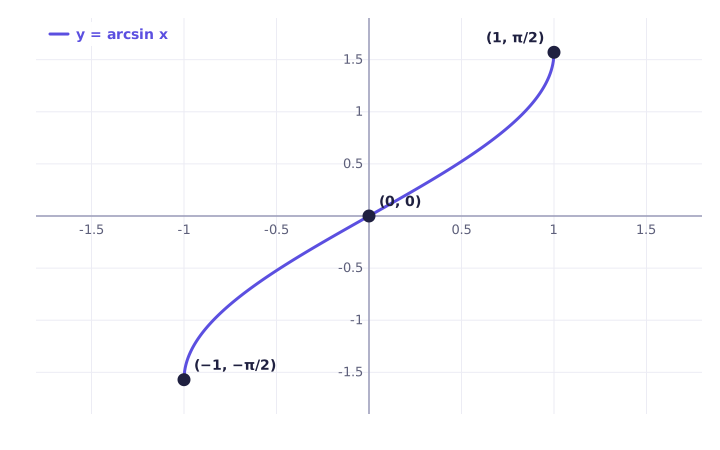
The graph is the piece of y = \sin x on \left[-\frac{\pi}{2}, \frac{\pi}{2}\right], reflected across the line y = x.
Key values of arcsine
| x | -1 | -\frac{\sqrt{3}}{2} | -\frac{1}{2} | 0 | \frac{1}{2} | \frac{\sqrt{2}}{2} | \frac{\sqrt{3}}{2} | 1 |
|---|---|---|---|---|---|---|---|---|
| \arcsin x | -\frac{\pi}{2} | -\frac{\pi}{3} | -\frac{\pi}{6} | 0 | \frac{\pi}{6} | \frac{\pi}{4} | \frac{\pi}{3} | \frac{\pi}{2} |
Properties of arcsine
- Domain [-1, 1], range \left[-\frac{\pi}{2}, \frac{\pi}{2}\right]. Inputs outside [-1, 1] are undefined, since no angle has sine 2.
- Increasing. Arcsine is strictly increasing on its whole domain.
- Odd. \arcsin(-x) = -\arcsin x.
- Cancellation. \sin(\arcsin x) = x for every x in [-1, 1], but \arcsin(\sin x) = x only for x in \left[-\frac{\pi}{2}, \frac{\pi}{2}\right].
- Relation to arccosine. \arcsin x + \arccos x = \frac{\pi}{2}. See arccosine.
Derivative of arcsin x
Why. Let y = \arcsin x, so \sin y = x. Implicit differentiation gives \cos y \cdot y' = 1, so y' = \frac{1}{\cos y}. Since y is in \left[-\frac{\pi}{2}, \frac{\pi}{2}\right], \cos y \ge 0, and \cos y = \sqrt{1 - \sin^2 y} = \sqrt{1 - x^2}. This is a special case of the inverse function rule.
At x = \pm 1 the denominator is zero, which is why the graph has vertical tangents at its endpoints.
Integrals involving arcsine
The derivative formula, read backward, is the integral you will use most:
The integral of arcsine itself comes from integration by parts with u = \arcsin x, dv = dx:
Worked examples
Example 1: chain rule. Differentiate f(x) = \arcsin(3x):
Example 2: a definite integral. \int_0^{1/2}\frac{dx}{\sqrt{1-x^2}} = \arcsin\frac{1}{2} - \arcsin 0 = \frac{\pi}{6}.
Example 3: using a. \int\frac{dx}{\sqrt{9 - x^2}} = \arcsin\frac{x}{3} + C.
Example 4: composition. Simplify \cos(\arcsin x). If \theta = \arcsin x then \sin\theta = x and \cos\theta \ge 0, so \cos(\arcsin x) = \sqrt{1 - x^2}.
Common mistakes
- Reading \sin^{-1}x as \frac{1}{\sin x}. The reciprocal is \csc x, covered on reciprocal trig functions.
- Giving an angle outside the range. \arcsin\left(-\frac{1}{2}\right) = -\frac{\pi}{6}, not \frac{7\pi}{6} or \frac{11\pi}{6}.
- Plugging in |x| > 1. \arcsin 2 does not exist as a real number.
- Forgetting the chain rule factor. \frac{d}{dx}\arcsin(x^2) = \frac{2x}{\sqrt{1 - x^4}}, not \frac{1}{\sqrt{1-x^4}}.
How arcsine connects to other topics
Arcsine is the backbone of the substitution x = a\sin\theta in trig substitution, used for integrals with \sqrt{a^2 - x^2}. Its siblings are arccosine and arctangent, and all three derivatives are derived the same way in the guide to implicit differentiation.
Practice it now
Implicit differentiation
Solve real problems on this topic with instant feedback, hints and a step-by-step walkthrough for every answer. Free, no sign-up needed to start.
Practice this lesson