Derivative of √x: Formula, Proof and Examples
The derivative of √x is 1/(2√x). See the power rule and limit proofs, the chain rule for √u, why x = 0 fails, and examples like √(x² + 1).
Powers, roots and polynomials Updated 2 min read
At a glance
- Derivative
- \dfrac{1}{2\sqrt{x}} for x > 0
- As a power
- \dfrac{d}{dx}\,x^{1/2} = \tfrac{1}{2}x^{-1/2}
- Chain rule form
- \dfrac{d}{dx}\sqrt{u} = \dfrac{u'}{2\sqrt{u}}
- At x = 0
- Not differentiable, the tangent is vertical
- Integral version
- \int \sqrt{x}\,dx = \frac{2}{3}x^{3/2} + C
On this page
The derivative of \sqrt{x} is \dfrac{1}{2\sqrt{x}}, for every x > 0. Roots are just fractional powers, so the power rule handles them.
Graph of √x and its derivative
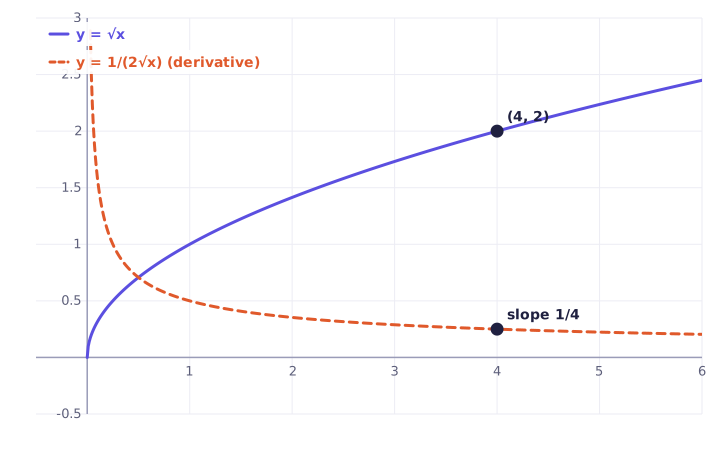
The derivative is always positive, so \sqrt{x} always increases. But it increases more and more slowly, which is why the curve bends down.
Proof with the power rule
Rewrite the root as a power, \sqrt{x} = x^{1/2}, and use the power rule:
Proof from the limit definition
Plugging in h = 0 gives \frac{0}{0}, so multiply top and bottom by the conjugate \sqrt{x + h} + \sqrt{x}:
Now let h \to 0 to get \frac{1}{\sqrt{x} + \sqrt{x}} = \frac{1}{2\sqrt{x}}.
Why x = 0 is a problem
At x = 0 the formula would divide by zero. The difference quotient there is \frac{\sqrt{h}}{h} = \frac{1}{\sqrt{h}}, which grows without bound as h \to 0^+. The tangent line at the origin is vertical, so \sqrt{x} is not differentiable at 0.
The chain rule version: derivative of √u
| Function | Inside u | Derivative |
|---|---|---|
| \sqrt{3x} | 3x | \frac{3}{2\sqrt{3x}} |
| \sqrt{x^2 + 1} | x^2 + 1 | \frac{x}{\sqrt{x^2 + 1}} |
| \sqrt{1 - x^2} | 1 - x^2 | \frac{-x}{\sqrt{1 - x^2}} |
| \sqrt{\sin x} | \sin x | \frac{\cos x}{2\sqrt{\sin x}} |
Worked examples
Example 1: combine powers first. Differentiate x\sqrt{x}. Since x\sqrt{x} = x^{3/2}:
Example 2: a quotient. \frac{1}{\sqrt{x}} = x^{-1/2}, so its derivative is -\frac{1}{2}x^{-3/2} = -\frac{1}{2x\sqrt{x}}.
Example 3: a tangent line. At x = 9, \sqrt{9} = 3 and the slope is \frac{1}{6}. The tangent is y = 3 + \frac{1}{6}(x - 9). This line is the basis for estimating \sqrt{10} \approx 3 + \frac{1}{6} \approx 3.167, a classic linear approximation. The true value is about 3.162.
Common mistakes
- Forgetting the 2. The answer is \frac{1}{2\sqrt{x}}, not \frac{1}{\sqrt{x}}.
- Lowering the exponent the wrong way. \frac{1}{2} - 1 = -\frac{1}{2}, not -\frac{3}{2} or \frac{3}{2}.
- Dropping u'. \frac{d}{dx}\sqrt{x^2 + 1} needs the factor 2x on top.
- Plugging in x = 0. The formula has no value at 0. Say the derivative does not exist there instead of writing \frac{1}{0}.
The reverse direction is on the integral of √x page. The square root function page covers its graph and domain.
Practice it now
The power rule
Solve real problems on this topic with instant feedback, hints and a step-by-step walkthrough for every answer. Free, no sign-up needed to start.
Practice this lesson