Integral of a Constant and of 1: Formula and Examples
The integral of a constant k is kx + C, and the integral of 1 is x + C. See why, the area picture, definite integrals and the mistakes to avoid.
Powers, roots and rational functions Updated 3 min read
At a glance
- Antiderivative
- kx + C
- Integral of 1
- \int 1\,dx = x + C
- Integral of 0
- \int 0\,dx = C
- Definite integral
- \int_a^b k\,dx = k(b - a)
- Check
- \dfrac{d}{dx}(kx + C) = k
On this page
The integral of a constant k is kx + C. In particular, the integral of 1 is x + C. It is the simplest integral in calculus, and almost every other integral uses it somewhere, usually as the last term of a polynomial.
Graph: a constant gives a rectangle
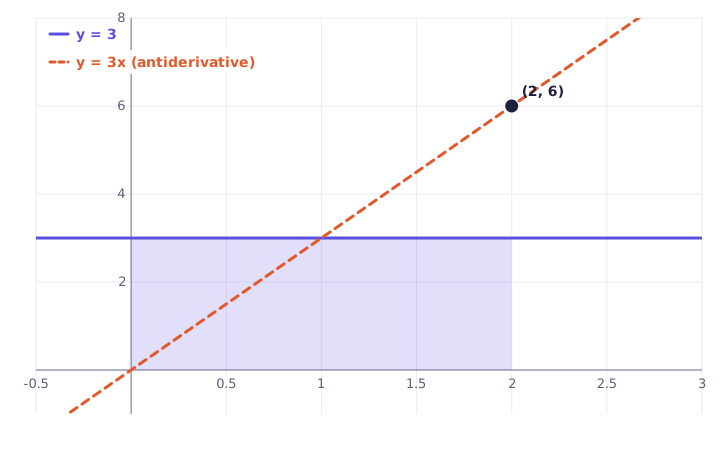
The area under a horizontal line is always a rectangle. Its height is k and its width is how far x has moved, so the accumulated area grows like kx. That is the whole formula in one picture.
Why the integral of k is kx + C
An integral asks: what function has this derivative? We want a function whose slope is k everywhere. A straight line with slope k does exactly that:
Adding any constant C moves the line up or down without changing its slope, so every function kx + C works. You can also see it as the reverse power rule with n = 0: since k = kx^0,
Check by differentiating
Always check an antiderivative by taking its derivative:
The matching derivative page is the derivative of a constant, which runs the same idea backwards: the derivative of any constant is 0.
Definite integrals of a constant
With the Fundamental Theorem of Calculus:
If k is negative, the rectangle sits below the axis and the answer is negative. For example, \int_0^4 (-2)\,dx = -8.
Worked examples
Example 1. \int 7\,dx = 7x + C.
Example 2: constants that look like variables. Any number without x counts as a constant, even if it is written with a symbol:
Example 3: inside a polynomial. Using the linearity rules:
The 9 becomes 9x. See the integral of x and the integral of x² for the other two terms.
Example 4: a different variable. \int 3\,dt = 3t + C. The variable in the answer matches the variable in dt.
Example 5: a definite integral. \int_{-1}^{4} 3\,dx = 3\big(4 - (-1)\big) = 15.
Common mistakes
- Integrating a constant to 0. That is the derivative rule. Integration goes the other way: \int 5\,dx = 5x + C, not 0.
- Writing 5 + C. The answer must contain x. Check: the derivative of 5 + C is 0, not 5.
- Forgetting + C. Without it you only have one antiderivative, not all of them.
- Treating e^2 or \pi^2 as a power of x. These are plain numbers. \int e^2\,dx is e^2x + C, not \frac{e^3}{3}.
Want more practice? Try the antiderivative practice problems or read the guide to antiderivatives.
Practice it now
The reverse power rule
Solve real problems on this topic with instant feedback, hints and a step-by-step walkthrough for every answer. Free, no sign-up needed to start.
Practice this lesson