Derivatives of Inverse Trig Functions: Formulas, Proofs, Examples
Learn the derivatives of arcsin, arccos, arctan and arcsec, see where each formula comes from, and follow worked chain rule examples step by step.
By the PracticeCalculus team Published 8 min read
On this page
- What are inverse trig functions?
- The derivative formulas for inverse trig functions
- Where does the derivative of arcsin come from?
- Where does the derivative of arctan come from?
- Where does the derivative of arcsec come from?
- Using the chain rule with inverse trig derivatives
- Worked example 1: derivative of arcsin(3x)
- Worked example 2: derivative of arctan(x²)
- Worked example 3: derivative of arccos(x/2)
- Worked example 4: product rule with arctan
- Worked example 5: arcsec of an exponential
- Common mistakes with inverse trig derivatives
- Why these derivatives matter for integration
- Quick reference: derivatives of inverse trig functions
- Practice until the formulas feel automatic
You know that the derivative of \sin x is \cos x. But what is the derivative of \arcsin x? It turns out to have no trig in it at all: it is an algebraic expression with a square root. That surprise trips up a lot of students, and so do the signs, the absolute values and the chain rule factors that come with these formulas.
This guide gives you all six formulas for the derivatives of inverse trig functions, shows exactly where each one comes from, and walks through worked examples so you can apply them with confidence.
What are inverse trig functions?
An inverse trig function answers the question: which angle gives this value? For example, \arcsin(0.5) asks for the angle whose sine is 0.5, and the answer is \frac{\pi}{6}.
Because sine, cosine and tangent repeat forever, each one is restricted to a single interval before it is inverted, so that every input gets exactly one output:
| Function | Domain | Range (output angles) |
|---|---|---|
| \arcsin x | -1 \le x \le 1 | -\frac{\pi}{2} \le y \le \frac{\pi}{2} |
| \arccos x | -1 \le x \le 1 | 0 \le y \le \pi |
| \arctan x | all real x | -\frac{\pi}{2} < y < \frac{\pi}{2} |
These ranges matter. They are what decide the sign of a square root in the derivations below. You can review the graphs on the reference pages for arcsine, arccosine and arctangent.
A notation warning before we start: \sin^{-1} x means \arcsin x. It does not mean \frac{1}{\sin x}.
The derivative formulas for inverse trig functions
Here are all six. The three on the left are the ones you will use most:
Notice the pattern: each "co" function (arccos, arccot, arccsc) is just the negative of its partner. So you really only need to memorize three formulas.
Tip: arcsin has 1 - x^2 under a root, arctan has 1 + x^2 with no root. Mixing those two up is the most common memorization slip.
Where does the derivative of arcsin come from?
You do not have to take these formulas on faith. Each one comes from implicit differentiation plus a Pythagorean identity.
Let y = \arcsin x. By definition of the inverse, that means
Differentiate both sides with respect to x, remembering that y is a function of x so the chain rule applies on the left:
Now rewrite \cos y in terms of x. From \sin^2 y + \cos^2 y = 1 we get \cos y = \pm\sqrt{1 - \sin^2 y} = \pm\sqrt{1 - x^2}.
Which sign? Since y lives in \left[-\frac{\pi}{2}, \frac{\pi}{2}\right], cosine is never negative there. So we take the positive root:
The derivation for arccos is identical except that \frac{d}{dx}\cos y = -\sin y, which produces the minus sign. Another way to see it: \arccos x = \frac{\pi}{2} - \arcsin x, so the derivatives must be negatives of each other.
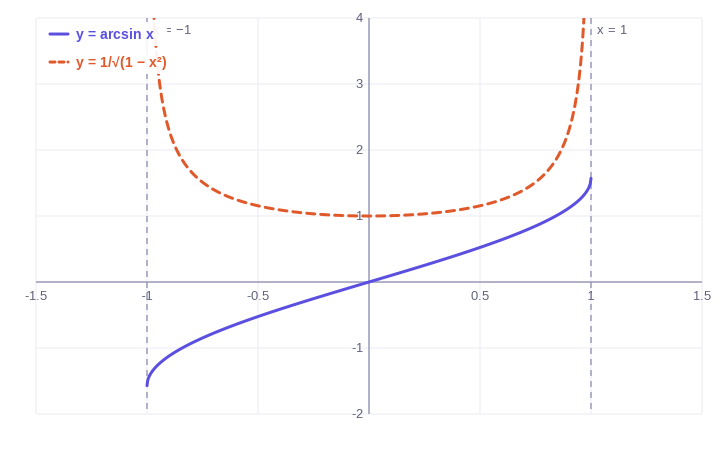
The graph explains why the formula only works for -1 < x < 1. At the endpoints the arcsin curve stands straight up, and a vertical tangent has no finite slope.
Where does the derivative of arctan come from?
Let y = \arctan x, so \tan y = x. Differentiate implicitly:
Use the identity \sec^2 y = 1 + \tan^2 y = 1 + x^2:
No sign decision this time, because 1 + x^2 is always positive. That also tells you something about the graph: arctan is increasing everywhere.
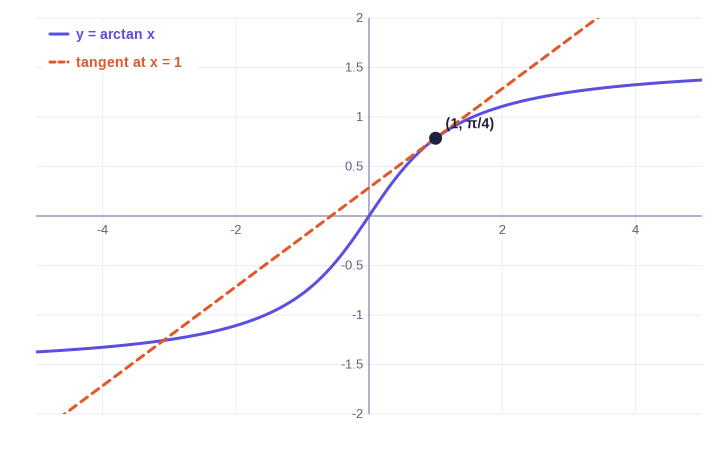
The curve flattens toward its horizontal asymptotes y = \pm\frac{\pi}{2}, which matches the derivative \frac{1}{1+x^2} shrinking toward 0 as \lvert x \rvert grows.
Where does the derivative of arcsec come from?
Let y = \operatorname{arcsec} x, so \sec y = x, with \lvert x \rvert \ge 1 and y in [0, \pi], y \ne \frac{\pi}{2}. Differentiate:
We know \sec y = x and \tan^2 y = \sec^2 y - 1 = x^2 - 1. In the first quadrant \sec y and \tan y are both positive; in the second quadrant both are negative. Either way their product is positive, so \sec y \tan y = \lvert x \rvert\sqrt{x^2-1}, giving
That absolute value is not decoration. Without it, the formula would wrongly say arcsec is decreasing for x < -1. (A few textbooks define arcsec with a different range and drop the absolute value, so check your course's convention.)
Using the chain rule with inverse trig derivatives
In practice you rarely see plain \arcsin x. Usually there is an inside function. The general versions are:
The recipe is the same as in our chain rule guide: plug the inside into the formula, then multiply by the derivative of the inside.
Worked example 1: derivative of arcsin(3x)
Differentiate y = \arcsin(3x).
Step 1. Identify the inside. u = 3x, so u' = 3.
Step 2. Plug u into the formula. \frac{1}{\sqrt{1 - (3x)^2}} = \frac{1}{\sqrt{1 - 9x^2}}.
Step 3. Multiply by u'.
Watch the square: (3x)^2 = 9x^2, not 3x^2.
Worked example 2: derivative of arctan(x²)
Differentiate y = \arctan(x^2).
Step 1. Inside: u = x^2, so u' = 2x.
Step 2. Formula with u: \frac{1}{1 + (x^2)^2} = \frac{1}{1 + x^4}.
Step 3. Multiply by u':
Worked example 3: derivative of arccos(x/2)
Differentiate y = \arccos\left(\frac{x}{2}\right).
Step 1. Inside: u = \frac{x}{2}, so u' = \frac{1}{2}.
Step 2. Apply the arccos formula, keeping the minus sign:
Step 3. Simplify. Write 1 - \frac{x^2}{4} = \frac{4 - x^2}{4}, so \sqrt{1 - \frac{x^2}{4}} = \frac{\sqrt{4-x^2}}{2}. Then
This is a handy general fact: \frac{d}{dx}\arcsin\left(\frac{x}{a}\right) = \frac{1}{\sqrt{a^2-x^2}} for a > 0, and arccos gives the negative.
Worked example 4: product rule with arctan
Differentiate y = x\arctan x and find the slope at x = 1.
This is a product, so use the product rule with f = x and g = \arctan x:
At x = 1:
Worked example 5: arcsec of an exponential
Differentiate y = \operatorname{arcsec}(e^x) for x > 0.
Step 1. Inside: u = e^x, so u' = e^x. Since x > 0, e^x > 1, so we are inside the domain.
Step 2. Apply the formula:
Step 3. Simplify. e^x is always positive, so \lvert e^x \rvert = e^x cancels with the numerator:
Common mistakes with inverse trig derivatives
- Reading \sin^{-1} x as \frac{1}{\sin x}. The reciprocal is \csc x, whose derivative is -\csc x\cot x. The inverse is arcsin, whose derivative is \frac{1}{\sqrt{1-x^2}}.
- Swapping the arcsin and arctan formulas. Writing \frac{1}{\sqrt{1+x^2}} or \frac{1}{1-x^2}. Remember: arcsin has a root and a minus; arctan has no root and a plus.
- Dropping the minus sign on arccos, arccot or arccsc. These functions decrease, so their derivatives are negative.
- Forgetting the chain rule factor. \frac{d}{dx}\arctan(5x) is \frac{5}{1+25x^2}, not \frac{1}{1+25x^2}.
- Squaring only part of the inside. In \arcsin(3x), the root contains 1 - 9x^2, not 1 - 3x^2.
- Losing the absolute value in arcsec. Without it, you get the wrong sign for x < -1.
- Ignoring the domain. \frac{1}{\sqrt{1-x^2}} only makes sense for \lvert x \rvert < 1. If a problem asks for the derivative of \arcsin x at x = 2, the answer is that it does not exist.
For more slips like these, see 12 common calculus mistakes.
Why these derivatives matter for integration
Reading the formulas backward gives two integrals you will use constantly in Calculus 2:
That is why a rational function like \frac{1}{1+x^2}, which has no trig in it, integrates to a trig expression. See the integral pages for 1/(1 + x²) and 1/√(1 − x²), and you will meet these again in trig substitution and partial fractions.
Quick reference: derivatives of inverse trig functions
| Function | Derivative | Valid for |
|---|---|---|
| \arcsin x | \frac{1}{\sqrt{1-x^2}} | \lvert x \rvert < 1 |
| \arccos x | -\frac{1}{\sqrt{1-x^2}} | \lvert x \rvert < 1 |
| \arctan x | \frac{1}{1+x^2} | all x |
| \operatorname{arccot} x | -\frac{1}{1+x^2} | all x |
| \operatorname{arcsec} x | \frac{1}{\lvert x \rvert\sqrt{x^2-1}} | \lvert x \rvert > 1 |
| \operatorname{arccsc} x | -\frac{1}{\lvert x \rvert\sqrt{x^2-1}} | \lvert x \rvert > 1 |
| \arcsin(u) | \frac{u'}{\sqrt{1-u^2}} | \lvert u \rvert < 1 |
| \arctan(u) | \frac{u'}{1+u^2} | all u |
For individual walkthroughs, see the derivative pages for arcsin x, arccos x, arctan x, arcsec x and arccot x. If you want the general principle behind all of them, the inverse function rule shows how the derivative of any inverse relates to the derivative of the original function.
Practice until the formulas feel automatic
Inverse trig derivatives are short formulas, but exams love to wrap them in the chain rule, the product rule and a sign or two. The fastest way to stop mixing them up is to work a batch of problems with immediate feedback. The interactive lesson below gives you exactly that: each question checks your answer instantly, flags a missing chain rule factor or a dropped minus sign, and shows the full solution so the patterns stick.
Practice it now
Inverse trig derivatives
Solve real problems on this topic with instant feedback, hints and a step-by-step walkthrough for every answer. Free, no sign-up needed to start.
Practice this lesson