Derivative of arcsin x: Formula, Proof and Examples
The derivative of arcsin x is 1/√(1 − x²). See the proof from sin y = x, the chain rule form for arcsin(u), a graph and worked examples.
Inverse trig derivatives Updated 2 min read
At a glance
- Derivative
- \dfrac{1}{\sqrt{1 - x^2}} for -1 < x < 1
- Chain rule form
- \dfrac{d}{dx}\arcsin u = \dfrac{u'}{\sqrt{1 - u^2}}
- Domain of arcsin x
- [-1, 1]
- Range of arcsin x
- \left[-\frac{\pi}{2}, \frac{\pi}{2}\right]
- Integral version
- \int \frac{1}{\sqrt{1 - x^2}}\,dx = \arcsin x + C
On this page
The derivative of \arcsin x is \dfrac{1}{\sqrt{1 - x^2}}. It holds on the open interval -1 < x < 1, where the inverse sine is smooth.
Graph of arcsin x and its derivative
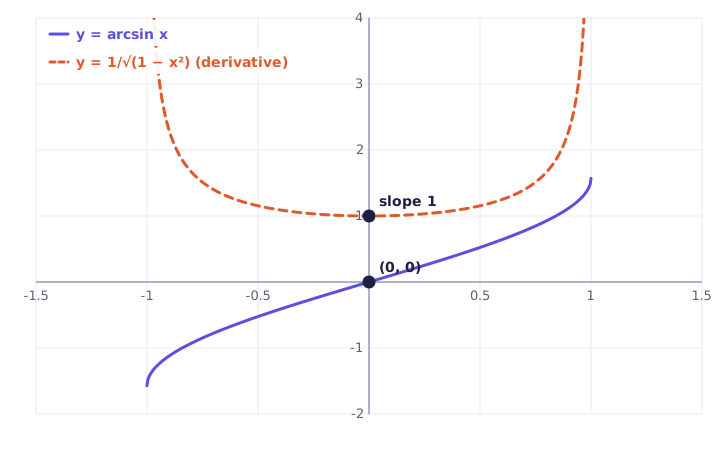
The derivative is never negative, so \arcsin x always rises. Its smallest slope is 1 at the origin, and the curve turns vertical at the endpoints (\pm 1, \pm\frac{\pi}{2}).
Proof of the derivative of arcsin x
Let y = \arcsin x. Then \sin y = x with -\frac{\pi}{2} \le y \le \frac{\pi}{2}. Differentiate both sides with implicit differentiation:
Now write \cos y in terms of x. From \sin^2 y + \cos^2 y = 1 we get \cos y = \pm\sqrt{1 - x^2}. On \left[-\frac{\pi}{2}, \frac{\pi}{2}\right] cosine is never negative, so we take the positive root:
The same idea works for every inverse function, see the inverse function rule.
Chain rule version: derivative of arcsin(u)
With the chain rule, put the inside derivative on top:
| Function | Inside u | Derivative |
|---|---|---|
| \arcsin(2x) | 2x | \frac{2}{\sqrt{1 - 4x^2}} |
| \arcsin(x^2) | x^2 | \frac{2x}{\sqrt{1 - x^4}} |
| \arcsin\!\left(\frac{x}{a}\right), a > 0 | \frac{x}{a} | \frac{1}{\sqrt{a^2 - x^2}} |
| \arcsin(e^x) | e^x | \frac{e^x}{\sqrt{1 - e^{2x}}} |
The third row is worth remembering. It is why \int \frac{dx}{\sqrt{a^2 - x^2}} = \arcsin\frac{x}{a} + C.
Worked examples
Example 1: a product. Differentiate f(x) = x\arcsin x with the product rule:
Example 2: a slope at a point. The slope of y = \arcsin x at x = \frac{1}{2} is
Example 3: a power of arcsin. For g(x) = (\arcsin x)^2 the outer function is a square:
Common mistakes
- Reading \sin^{-1} x as \frac{1}{\sin x}. The -1 means inverse function, not reciprocal.
- Forgetting the inside derivative. \frac{d}{dx}\arcsin(3x) is \frac{3}{\sqrt{1 - 9x^2}}, not \frac{1}{\sqrt{1 - 9x^2}}.
- Squaring only x in the chain rule. Inside the root you need 1 - u^2, so \arcsin(x^2) gives \sqrt{1 - x^4}, not \sqrt{1 - x^2}.
- Mixing up the sign with arccos. The derivative of arccos x is the same expression with a minus sign.
Going the other way, the integral of 1/√(1 − x²) is \arcsin x + C, and the integral of arcsin x uses integration by parts. Practise more with inverse trig derivative problems or read about the arcsine function.
Practice it now
Inverse trig derivatives
Solve real problems on this topic with instant feedback, hints and a step-by-step walkthrough for every answer. Free, no sign-up needed to start.
Practice this lesson