Integral of eˣ: Formula, Steps and Examples
The integral of eˣ is eˣ + C. See why eˣ is its own antiderivative, a graph of the area, definite and improper integrals and worked examples.
Exponential and log integrals Updated 3 min read
At a glance
- Antiderivative
- e^x + C
- From 0 to 1
- e - 1 \approx 1.718
- From −∞ to 0
- 1
- With a linear inside
- \int e^{kx+b}\,dx = \frac{1}{k}e^{kx+b} + C
- Derivative
- \frac{d}{dx}e^x = e^x
On this page
The integral of e^x is e^x + C. The natural exponential is the only function (apart from multiples of it) that is its own derivative, so it is also its own antiderivative.
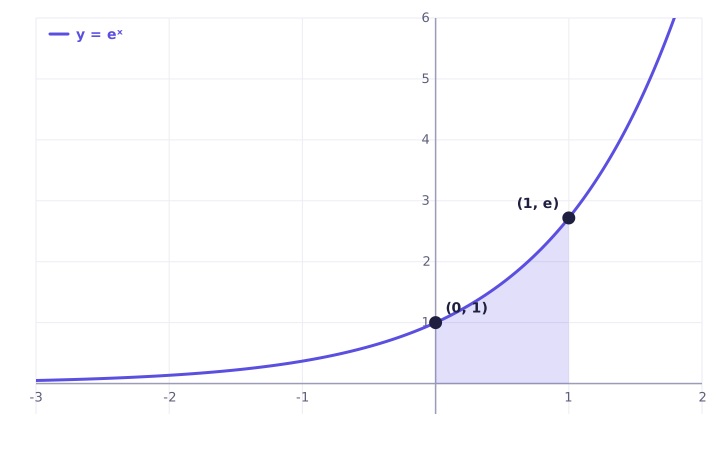
Graph of eˣ with the area from 0 to 1
Why the integral of eˣ is eˣ
An antiderivative of f is any function whose derivative is f. The derivative of eˣ is e^x, so e^x works:
That is the whole proof. The + C is there because any constant has derivative zero, so e^x + 5 and e^x - 2 are antiderivatives too. The antiderivatives guide explains why every antiderivative has this form.
Step by step: integrals built from eˣ
- Pull out constants. \int 4e^x\,dx = 4e^x + C, by the constant multiple rule.
- Split sums. \int (e^x + x^2)\,dx = e^x + \frac{x^3}{3} + C.
- Rewrite shifted exponents. e^{x+2} = e^2\cdot e^x, so \int e^{x+2}\,dx = e^{x+2} + C.
- Divide by the inside slope. If the exponent is kx + b, the answer is \frac{1}{k}e^{kx+b} + C. The integral of e²ˣ page covers this case in detail.
Check by differentiating
For \frac{1}{k}e^{kx+b}, the chain rule gives \frac{1}{k}\cdot e^{kx+b}\cdot k = e^{kx+b}. The factor \frac{1}{k} is exactly what cancels the k from the chain rule.
Definite and improper integrals
By the Fundamental Theorem of Calculus, \int_a^b e^x\,dx = e^b - e^a.
| Integral | Value |
|---|---|
| \int_0^1 e^x\,dx | e - 1 \approx 1.718 |
| \int_0^{\ln 2} e^x\,dx | 2 - 1 = 1 |
| \int_{-1}^{1} e^x\,dx | e - \frac{1}{e} \approx 2.350 |
| \int_{-\infty}^{0} e^x\,dx | 1 - \lim_{a\to-\infty}e^a = 1 |
The last one is an improper integral. The left tail of e^x goes on forever, but it shrinks so fast that its total area is exactly 1.
Worked examples
Example 1: a sum. \displaystyle\int (3e^x - 2x)\,dx = 3e^x - x^2 + C.
Example 2: e in the base and the exponent. \displaystyle\int e^{x}e^{2}\,dx = e^2 e^x + C = e^{x+2} + C. Combine exponents only when the bases match.
Example 3: a substitution. \displaystyle\int \frac{e^x}{1 + e^x}\,dx. Let u = 1 + e^x, du = e^x\,dx:
No absolute value is needed since 1 + e^x > 0.
Example 4: the exponent is a function. \displaystyle\int 2x\,e^{x^2}\,dx. With u = x^2, du = 2x\,dx, this is \int e^u\,du = e^{x^2} + C. This only works because the 2x is there. Without it, \int e^{x^2}\,dx has no elementary answer; see the integral of e^(x²).
Example 5: average value. The average of e^x on [0, 1] is \frac{1}{1-0}\int_0^1 e^x\,dx = e - 1 \approx 1.718.
Common mistakes
- Using the power rule. \int e^x\,dx \ne \frac{e^{x+1}}{x+1}. The power rule is for x^n, where the variable is the base.
- Forgetting to divide by k. \int e^{5x}\,dx = \frac{1}{5}e^{5x} + C, not e^{5x} + C.
- Dividing by a non-constant. \int e^{x^2}\,dx \ne \frac{e^{x^2}}{2x}. Differentiate that and you will not get e^{x^2} back.
- Dropping + C on an indefinite integral.
For other bases such as 2^x, see the integral of 2ˣ. The natural exponential function page explains where e comes from.
Practice it now
Sine, cosine, eˣ and 1/x
Solve real problems on this topic with instant feedback, hints and a step-by-step walkthrough for every answer. Free, no sign-up needed to start.
Practice this lesson